a img { display:none; } a:hover img { display:block; } -->
Showing posts with label Canucks. Show all posts

Thursday, September 24, 2020

Lost Cards: 1995-96 Upper Deck Collector's Choice Gary Leeman


   Gary Leeman is best known for two things - scoring 50 goals as a Maple Leaf, and being traded for Doug Gilmour.  Or at least, that is how I remember him.  

  Leeman was drafted by the Toronto Maples in the 2nd round, 24th overall, in the 1982 NHL Entry Draft.  He was drafted as a defenseman.  After scoring 86 points in 70 games with the Regina St. Pats of the WHL, he won the Bill Hunter Trophy as the league's best  Defenceman and was a 1st Team All-star.  After the WHL season ended for the St. Pats, Leeman made his NHL debut, playing two games in the 1983 play-offs in the first round against the Minnesota North Stars.

1982-83 OPC Gary Leeman (pre-RC)

  Gary broke camp as a member of the Maple Leafs for the 1983-84 season.  Leeman scored his first career NHL goal on December 10th, 1983, against Reggie Lemelin of the Calgary Flames.  Since was still under 20, the Leafs loaned him to Team Canada to play in the World Junior Hockey Championships.  Canada finished 4th.  Leeman finished his rookie season with 4 goals and 8 assists in 52 games.  It earned him a rookie card in the 1984-85 OPC set

  During the 1984-85 season, Leeman began to spend more time as a forward and eventually made the transition to a full-time.  Gary struggled through the injury bug during his first three NHL seasons, playing in 52, 53 and 53 games during his first three NHL seasons.  

1985-86 OPC Gary Leeman

  Gary started to show signs of breaking out during the 1985-86 season.  He had 32 points in 53 games during the regular season .  A turning point was a two month trip to the AHL in January.  He scored 28 points in 23 games with the St. Catherine's Saints.  Upon being recalled,  Leeman scored five points in the last five regular season games and then added 12 points in 10 play-off games.  Leeman did not make either the 85-86 or 86-87 OPC sets.

1986-87 OPC Gary Leeman

  Gary built on his late season success during the following season.  He had 52 points in 80 games, including 20 goals, during the 1986-87 season.  Gary followed that up with back-to-back 30 goal seasons.  It was all a lead-up to a career season in 1989-90.  Leeman led the Leafs with 51 goals and 95 Points.  He became only the second player in Toronto Maple Leafs history to score 50+ goals in a a season.  Leeman and the Leafs ended the 1980's as a team on the rise.  The Leafs had a solid youth core, including players like Leeman who had improved on his point total in each of his seven NHL seasons.  As a team, the Leafs finished 3rd in the league in goals.  
  It all came crashing down in the 1990-91 season.  The Leafs dropped to 18th in the leagues for goals scored, and Leeman regressed to scoring only 17 goals and 29 points in 52 games.  Leeman missed two months of the season with a shoulder injury.  Although before the injury Leeman only had 5 goals and 10 points in 19 games.  Leeman did shows signs of life near the end of the season, netting 6 goals and an assist in the final 10 games.  There was also discord in the dressing room.  Teammate Al Iafrate was going through a rough divorce and Leeman was dating his ex-wife.  Iafrate requested a trade due to personal reasons.  He was traded in January, while Leeman was injured.
  The following season was no better for Leeman.  He was suspended for four games for hitting Minnesota North Stars player Mark Tinordi across the jaw with his stick.  His goal total continued to nose-dive.  He had 7 goals in 34 games before the Leafs traded him to the Calgary Flames, in one of the all-time bad trades in NHL history.  It was a ten-player deal, which is the largest in NHL history, and the one in which the Leafs received Doug Gilmour.  
  Leeman was buried on the depth chart of the Flames, behind Theo Fleury and Sergei Makarov.  Over parts of two seasons with the Flames, Leeman had 11 goals and 23 points in 59 games.  During the 1992-93 season, Leeman again asked to be traded and was sent to the Montreal Canadiens for Brian Skrudlund.  The trade put some spring back in Leeman's stride, as he netting 13 points in his first 9 games as a Canadien.  He slowed down as the season came to an end, finishing with a total of 18 points in 20 games as a Hab in 92-93.  Leeman suffered an ankle injury on April 2nd and missed the final five games of the regular season and first two of the play-offs.  Leeman was nagged by injuries throughout the play-offs and only played in 11 of the Canadiens 20 play-off games, scoring 3 points.  He did dress for the entire Stanley Cup Finals and got to lift Lord Stanley's Mug as NHL champion. 

1993-94 Score Gary Leeman

  While writing up this post, I decided I should try to make a card out of the picture of Leeman hoisting the Cup.  I went with 1993-94 Score since I figured I could create a template quickly and I like the simplicity of it.  Unfortunately, the font wasn't that simple.  The font I used was the closest font I could find, but it's still a bit off.  I almost went against posting this.
  Injuries continued to nag Leeman.  Leeman played only 31 games, scoring 15 points, during the 1993-94 season.  He missed time due to shoulder and forearm injuries.  Leeman also played 23 games with the Canadiens; farm team in the AHL.  Leeman was a free agent for the 1994-95 season, which was a lock-out shortened season.  Leeman signed on with the Vancouver Canucks.  In ten games, he scored goals.  He didn't play in the final two months or play-offs for the Canucks, or their farm team.  I am not sure if there was another injury or a healthy scratch.
  After playing in Europe for the 1995-96 season, Leeman took another crack at the NHL.  He played two games for the St. Louis Blues, scoring one assist, while spending the rest of the season in the minor leagues.  Leeman returned to Europe for the 1996-97 and played there until he retired in 1999.
  Leeman finished his career with 199 goals and 466 points in 667 games.  After scoring 51 goals in 80 games during the 1989-90 season, he finished his career scoring 47 goals in his last 208 games.
  Leeman's last NHL card was an autograph insert from the 1994-95 BAP set.  Which is arguably not a NHL set, since it was only authorized by the NHLPA and not the NHL.  All the players were either featured in street clothes or NHLPA jerseys from the 4-on-4 NHLPA charity games they played during the lock-out.  So while it was a Vancouver card of Leeman, it was not a Vancouver Canucks card.  I couldn't find a picture of Leeman from his two game stint as a Blues, so instead Leeman's career capper is a 1995-96 Upper Deck Collector's Choice.  

1995-96 Collector's Choice Gary Leeman

1995-96 Collector's Choice Gary Leeman

Sunday, September 22, 2019

Fan Requests

  Okay, maybe I am exaggerating by saying fan requests, but on my Lost Page: 85-86 OPC, Mike said if he could add a card to the 85-86 set, it would be Petri Skirko.  Petri led the Canucks in points in his sophomore season and had four straight season of 30+ goals.  His rookie card was in the 86-87 OPC set, which was a very peculiar picture.  He's not even looking at the camera.  For the card I made below there is an fairly big issue.  The Canucks had the Flying V jerseys until the 1984-85 season, so this picture is from sometime after the set was actually released.  I originally had the perfect picture for the card but things didn't quit look right.  First off was the helmet on Petri was different than anything else he had worn and next was the mask on the goalie in background.  Turns out I almost posted  Lars Molin as Petri Skriko card.  So the card below is a bit of a cheat.  I actually believe, based on the patch on the hip, this picture is from the 1986-87 season.  I could not find a suitable picture of Skriko in a Flying V jersey.  Mike also suggested a Todd Bergen and Mats Thelin.  The Bergen will posted as a Lost Rookie in the upcoming weeks.  Thelin is in the queue for a Lost Rookie.

1985-86 OPC Petri Skriko (RC)


  Bossman22 commented on a few posts, basically any post that had Mike Bossy and wanted more Mike Bossy.  Since the Islanders and Bossy were my favourites as a child, I actually had one in the queue already.  Been working on a few more Bossy's to celebrate his 50 in 50 accomplishment but can't quite decide on the frame.


1989-90 OPC Mike Bossy

  If you have a player you would like to see in a 80s set, or another set I have already posted, comment below.  If it inspires me, it will likely show up on the blog at a later date.

Thursday, August 29, 2019

Lost Cards: 1987-88 OPC Thomas Gradin

 In 1978 off-season, the Canucks delved into the European market.  Within three days, they signed Swedish leagues players Lars Zetterstorm, Lars Lindgren, and Swedish NHLer Roland Eriksson.  A week later they traded for their future team career points leader, Swedish player Henrik Sedin, I mean Thomas Gradin.
  Gradin was easily the best of the four Swedish players the Canucks acquired in the summer of 1978.  Originally drafted by the Chicago Black Hawks, 45th overall in 1976, Gradin never signed with the Black Hawks.  Two years later, the Hawks traded Gradin to the Canucks for a second round pick, with the Hawks option of 1979 or 1980.  The Hawks passed in 1979, Canucks drafted Brent Ashton, 26th overall, which left the Hawks with 28th overall pick in 1980 (Steve Ludzik).
  Gradin scored 51 points in his rookie season, including 3 points in his first career NHL game.  Thomas led the Canucks in points during the 80-81 season, 69pts, and the 81-82 season, 86pts.  During their surprising run to the 1982 Stanley Cup finals, he led the team with 19 points.

1986-87 OPC Thomas Gradin

  Gradin left the Canucks for the Boston Bruins as a free agent in the 1987 off-season.  At the time, he was the Canucks franchise leader in points, 550.  Gradin scored 43 points in 61 games during his only season with Bruins and his final NHL season.  Gradin left the NHL and returned to the Swedish league in 1988.  He retired in 1990, but made a brief return to professional hockey in Sweden in 1997.
  Gradin returned to the Canucks organization 1994, as a scout.  He was instrumental in the Canucks pursuit and acquisition of the Sedin twins in the 1999 NHL draft.
  Gradin's last NHL card was in the 1985-86 set.  I had a chance to rectify two oversights on OPC's behalf.  Gradin was never pictured in the glorious mustard yellow home jersey of the Canucks.  So I took artistic license and used an older picture of Gradin for the 86-87 OPC above.  If OPC can use old pictures, then so can I.  Second was giving Gradin a career capping card as a member of the Boston Bruins.

1987-88 OPC #270 Thomas Gradin

1987-88 OPC #270 Thomas Gradin


Friday, April 26, 2019

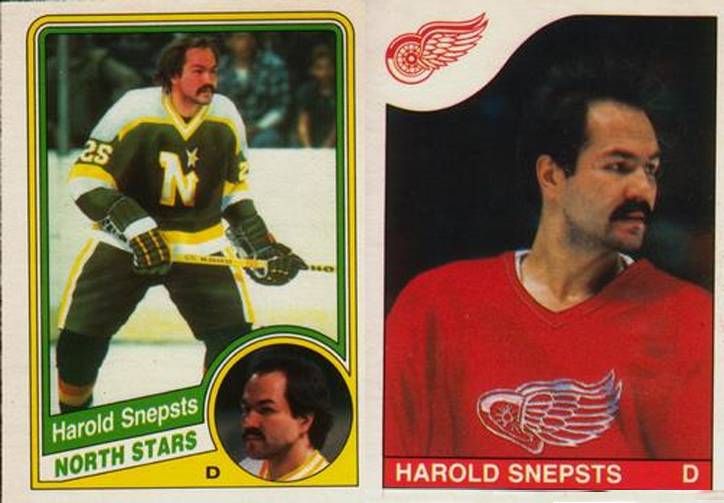
Lost Cards: 1987-88 OPC Harold Snepsts

  The Man.  The Legend.  The Moustache.  Harold Snepsts.  A clean cut Snepsts started out with the Vancouver in 1974.  Somewhere along the way, Snepsts found his inner Henry Boucha, sans headband, and rest became legend.
  Although somewhere along the way O-Pee-Chee and Topps lost their way.  Snepsts was traded to the Minnesota North Stars in 1984 and then signed as a free agent with the Detroit Red Wings in 1985.  Snepsts received the dreaded airbrush treatment in back-to-back sets before taking a hiatus until the 1989-90 OPC set.

1984-85 OPC and 1985-86 Airburshed Harold Snepsts
  So I decided to rectify the situation and reskin the 1984-85 and 1985-86 OPC cards.  While I was doing it, I considered how Snepsts switched teams during the offseason, so I made a design for the teams Snepsts player for the previous season, and the team he began the season with.

1984-85 OPC Harold Snepsts 1984-85 OPC Harold Snepsts
  During the 1984 off-season, the Canucks traded Snepsts to the North Stars straight up for Al McAdam.  McAdam would play a single season for the Canucks.  The following season, McAdam failed to make the Canucks out of training camp and would retire after playing a dozen games in the AHL.


1985-86 OPC Harold Snepsts

  Snepsts would lead the North Stars in PIM during his single season in Minnesota.  During the 1985 off season, Snepsts would be a free agent and signed a one-year deal with the Red Wings.

1986-87 OPC Harold Snepsts

  Snepsts' time with the Red Wings was plagued by injuries, as he only played in 120 regular season games during three seasons with the Wings.  What he did bring, was veteran leadership to a young Red Wings team, that included Steve Yzerman.  Snepsts best season with the Wings was 1986-87, in which he played 54 games and had 14 points.  So I would put his exclusion from the 1987-88 set as the most glaring omission during Snepsts time as a Red Wing, and thus the most deserving of a Lost Card.


1987-88 OPC #268 Harold Snepsts


1987-88 OPC #268 Harold Snepsts

  Snepsts would return as a free agent to the Vancouver Canucks for the 1988-89 season.  The following season the Canucks traded Snepsts to the St. Louis Blues, in a deal that saw Adrien Plavsic, who was 15 years Harold's junior, head to Vancouver.  The injuries continued to mount as Snepsts creeped up and played his 1000th career game on December 8th, 1990.  Snepsts retired at the end of the 1990-91 season with 1054 career games played.

Thursday, March 21, 2019

Lost Rookies: 1984-85 OPC Michel Petit

  Last year I got an e-mail request for a Michel Petit 1984-85 OPC Card.  I never got a reply back from the person requesting the card, but after I realized that card would fit perfectly into the Lost Rookies, I made it anyways.
  Petit, a tough stay-at-home defender, played 16 seasons in the NHL from 1982 to 1998, including six seasons with the Vancouver Canucks.  Petit played for 10 different teams in his career.  In his last three seasons, Petit played on five different teams.  When Petit retired, he held the record for most franchises played for, a record since broken by Mike Sillinger.
  Petit played for a lot of bad teams during his injury plagued career, including the historically bad 1989-90 Quebec Nordiques.  In 1990-91, he had a league worst plus/minus of -34, splitting time between the Nordiques and Toronto Maple Leafs.  During his sixteen seasons, Petit played in the play-offs five times.  Four times his team was eliminated in the first round.  Petit did play two games in the 1997 Stanley Cup with the Philadelphia.  Petit got to play after multiple injuries to Flyers defencemen depleted the team.  The Flyers were swept by the Red Wings in those finals.
  Michel Petit would have a rookie card with the "New York Rangers" in the 1987-88 OPC set.  A card in which had his name misspelled.  For a player who had a 16 year career, Petit only had cards in 7 years, including no cards with his last seasons/teams.  Below is what a 1984-85 OPC Michel Petit rookie card may have been.


1984-85 OPC #400 - Michel Petit (RC)

Saturday, September 26, 2015

Lost Rookies: 1980-81 OPC Brent Ashton

  Brent Ashton is best known as, previously, being the most traded man in NHL History.  He was traded a total of nine times during his NHL career.  A career that started with the Vancouver Canucks in 1979.  Ashton scored 23 goals and 48 points in 123 games for the Canucks, before being traded to the Colorado Rockies, via the Winnipeg Jets, in the 1982 offseason.  Ashton did not earn a rookie card until the 1982-83 OPC set, after leading the Rockies in points.  Below is how a 1980-81 OPC Brent Ashton rookie card may have looked.


1980-81 OPC #397 Brent Aston (RC)

  Trivia:  Three of the players Ashton was traded for during his career, were 40 goal scorers.


1980-81 OPC #397 Brent Ashton (RC)

  Brent played a single season with the Colorado Rockies before the team moved to New Jersey.  OPC was pro-active for the 1982-83 set and had the team pictured in their new New Jersey Devils jerseys.  As opposed to a logoless team set like the Calgary/Atlanta Flames in the 1980-81 set.  While Ashton rocked a classic 80s mullet in his 82-83 card, I believe it's fitting to throw in an 82-83 Colorado Rockies Ashton card for the all the Colorado Rockies fans out there.

1982-83 OPC Brent Ashton

Sunday, August 18, 2013

TTM Success: Ryan Keslar

  Here's a TTM that I had written off.   I received it on June 1st, 2013, which was 794 days after I had sent it.  Holy cow!  Ryan Kesler signed one of two cards.  I had sent it c/o the Vancouver Canucks.  Very surprised, and happy, to get this one back.  But it does make you wonder where it was sitting for the past two years.
  Kesler was coming off a 41 goal season and was a major factor in the Canuck play-offs run in 2011.  He has not been able to recapture his play from that season.  He only had 49 points in 77 games in 2011-12 and was hampered by injuries in 2013.  Canucks will need Kesler to return to his 2011 form to be considered Stanley Cup Contenders in 2014.


Wednesday, July 31, 2013

TTM Success: Tanner Glass


  Tanner Glass tied for top spot in 2012-13 for games played.  He played in all 48 regular season games for the Pittsburgh Penguins.  During those 48 games, he scored one goal and one assist.  While playing for the Winnipeg Jets, he had a goal and an assist in the same game, and then added a fight to complete the Gordie Howe Hat Trick.  That fight, against Cody McCormick, was a finalist for fight of the year at hockeyfights.com.  Check it out below.  And if you don't think these guys respect each other, check out the rematch.  McCormick had Glass jerseyed, but allowed Glass to get his jersey back on before continuing with the fight.  What a beauty.


Saturday, July 20, 2013

The Forgotten: Rob McVicar

  Since Shots Against became an official stat for goalies in 1983, only four NHL goalies have played in a game, but never faced a shot.  Rob McVicar is one of those four.  On December 1st, 2005, McVicar played 2 minutes and 44 seconds of relief for the Vancouver Canucks in a 5-3 loss to the Edmonton Oilers.  While McVicar never faced a shot, he was on the ice for a Canucks goal and got to race to the bench for an extra attacker in the wayning minutes of the game.
  Another unique thing about Rob McVicar, is that he is the only NHL goalie to have been born in the Northwest Territorries.  McVicar was born in Hay River, NWT but he grew up in Brandon, Manitoba, so he can't be considered a true North of 60 product.
  McVicar was originally drafted by the Vancouver Canucks in the 5th round of 2002.  McVicar played the majority of his pro-career in the ECHL.  146 of McVicar's 181 career North American professional games came in the ECHL.  It was in his third pro season when he had a chance to play in the NHL.  When Canucks starter Dan Cloutier suffered a season ending injury on November 20th, McVicar was called up to be the back-up to Alex Auld.  It took 10 games, including four earlier in the season, while sitting on the bench before McVicar got his chance to play.  While he had no shots on net during his time on the ice, he failed to impress the Canucks.  The very next day, they traded for another goalie, Maxime Ouellet.  McVicar would be sent down, not to the Manitoba Moose, but down another level to the Victoria Salmon Kings ECHL.  After a few more seasons in the minors, McVicar took his game overseas and finished his pro career in Europe.
  That has to be bittersweet, playing 3 minutes in the NHL and never getting a chance to make a save.  Compound that by bouncing back and forth between the NHL and AHL and having the team trade for another goalie the day after the game.

  For playing his single game, McVicar has eleven rookies cards.  One neat thing is you can see a change in the equipment and mask used by McVicar.  I am assuming the top cards feature a picture of McVicar in training camp.  He had played the previous season withe Columbia Inferno of the ECHL.


Wednesday, April 10, 2013

2013 Trade Deadline Update


  The 2013 NHL Trade Deadline has come and gone.  Let's use that an excuse to make some retro update cards for some of the players traded in the days leading up the deadline.


  Brenden Morrow is following up his second least productive season in the NHL, with his least productive.  Morrow had 11pts in 29 games this year with the Dallas Stars before being traded to the Pittsburgh Penguins.  In seven games with the Pens so far, Morrow has one goal and one assist.  The Pens don't need Morrow for his scoring as much as they need him for his grit and toughness.


  The St. Louis Blues added a few veterans to its blueline at the trade deadline.  One of them was Jay Bouwmeester, whom the Blues acquired from the Calgary Flames.  While not expected to produce offensively, Bouwmeester had three assists in his first three games as a Blue


  Ryane Clowe was goalless in 28 games with the San Jose Sharks.  Hardly the type of player you'd think would create a buzz at deadline time.  The New York Rangers were interested and Clowe paid immediate dividends, scoring twice in his first game as a Ranger.


  The biggest name at the trade deadline was Jarome Iginla, who was reported to be traded twice in the same evening.  The first time to the Boston Bruins, and then to the Pittsburgh Penguins.  So far, Jarome has not lit up the scoresheets in Pittsburgh, having one goal and one assist in his first five games as a Pen.  Can Jarome win that elusive Stanley Cup this year with the Pens, or maybe he'll need to pull a Raymond Bourque and stick around for another year.


  There were two big name goalies on the block at the trade deadline, neither of them moved.  Roberto Luongo is still in Vancouver and Miikka Kiprusoff announced his plans for retirement, just so he could stay in Calgary.  That left Ben Bishop, the odd man out in Ottawa, to be the biggest name, and size, goalie to be moved at the trade deadline.  Bishop has started all four games for the Lightning since the trade, including a shutout in his Lightning debut.


  Marian Gaborik put up two 40 goal seasons in New York in the past three years but found himself in the doghouse in 2013 and eventually as a Blue Jacket.  For the first time ever, the Columbus Blue Jackets found themselves as buyers at the trade deadline and they made a splash by trading for Gaborik.  Gaborik has welcomed the move, scoring 5 points in his first 4 games for Columbus.


  The Philadelphia Flyers, a pre-season favourite to contend, are one of the biggest disappointments of the season.  Currently, sitting in 12th place in the East, it appears the Flyer won't even make the play-offs, but atleast they got tougher.  The Flyers acquired Jay Rosehill from the Toronto Maple Leafs.  Rosehill, who had not played in the NHL this season, joined the Flyers just in time for a game against the Toronto Maple Leafs.  Rosehill made the Leafs pay, beating up Leafs tough guy Colton Orr and also scoring the game-winning goal as the Flyer won the game 5-3.


  Jaromir Jagr found himself on the move, joining his third team in two seasons.  In his Bruins debut, Jagr would score the lone goal in a 1-0 Boston Bruins victory over the New Jersey Devils.  Jagr, who turned 41 this season, is looking for that elusive third Stanley Cup, after winning two in his first two seasons. 


   Derek Roy is the third former Dallas Star to be included in this update.  Roy was traded to the Vancouver Canucks to help provide some scoring depth.  Roy, who has been a borderline point a game player in his best seasons, has started slow with the Canucks, notching one assist and four shots on goal in three games since the trade. 


Thursday, March 21, 2013

1981-82 OPC Reboot: Leafs and Canucks

Toronto Maple Leafs

  The Toronto Maple Leafs finished in last place in the Adams Division, which was good enough for a play-off spot.  In 1980-81, the NHL would rank the teams by points and the top 16 made the play-offs.  The Leafs rode a five game unbeaten streak into the play-offs, just to be swept in three games by the New York Islanders.  The Islanders outscored the Leafs 20 to 4.  The Leafs used five different goalies in the regular season and three in the play-offs. 

Rk             Player Pos Age GP  W  L T/O  GA  GAA SO  MIN
1           Jiri  Crha   G  30 54 20 20  11 211 4.07  0 3112
2      Jim  Rutherford   G  31 18  4 10   2  82 5.12  0  961
3     Michel  Larocque   G  28  8  3  3   2  40 5.22  0  460
4         Curt  Ridley   G  29  3  1  1   0  12 5.81  0  124
5    Vincent  Tremblay   G  21  3  0  3   0  16 6.71  0  143
           Team Total          80 28 37  15 361 4.51  0 4800

1981-82 OPC #315 - Jiri Crha (RC)

  Jiri Crha was clearly the best Leafs goalie in the 1980-81 regular season, but when the topic is the worst Leafs goalie ever, his name tends to get mentioned.  It might have more to do with his last few games with the Leafs.  In 65 play-off minutes in 1981, he allowed 11 goals, for a 10.15 GAA.  In fact, he golds the record for highest GAA in a single play-off for a goalie who ever played more the 60 minutes.  Crha would never play another NHL game.  Crha's OPC card was the inspiration for this reboot.


1981-82 OPC #319 - Michel "Bunny" Larocque

  Michel Larocque shared the Vezina Trophy from the 1980-81 season.  He didn't share it with his Leafs teammates, he won it with his Canadiens teammates.  Larocque had a 3.03 GAA with the Canadiens, but with the Leafs, he had a 5.23 GAA.  For his career, he had a 2.83 GAA with Montreal, and a 4.87 GAA while playing for other teams.  One thing he did have, was a cool mask.  His 1982-83 OPC card is a contender for card of the year.
 

Bonus Leafs

1981-82 OPC Vincent Trembley(RC)

  Vincent Trembley posted a 6.71 GAA while losing all three games he played.  For that, the Leafs believed he was good enough to share the goalie duties the following season.  One of his career highlights of his career is a 4-0 shutout versus the Philadelphia Flyers on November 14th, 1981.  Other than that, he was the typical 80's Maple Leafs goalie - bad.

1981-82 OPC Curt Ridley

  Curt Ridley is best known as a Vancouver Canuck.  Ridley was traded to the Leafs in Febraury of 1980.  Ridley suffered a season ended injury in his third game as a Leaf.  A slapshot from the blueline went off his index finger in his catching hand.  It is notable since Jiri Crha would have to come off the bench to play, making him the first goalie to have ever defected from Europe and play in the NHL.  Ridley would play three more games the following season before retiring in 1982. 

1981-82 OPC Paul Harrison

  The Islanders were beating the Leafs so bad in the play-offs, that the Leafs brought in a goalie who had spent the entire season in the minors to stop the bleeding.  Paul Harrison had spent the entire 1980-81 season in the minors before getting called up by the Leafs.  Too bad he didn't play the entire series, he only allowed one goal in 40 minutes compared to 19 the other goalies had allowed in 140 minutes.  Perhaps he played great, or perhaps the Islanders grew tired of scoring.


1981-82 OPC Jim Rutherford

  Jim Rutherford was traded twice during the 1980-81 season.  He finished the season with Los Angeles, so he really shouldn't have a Maple Leafs card in this reboot.  He played 18 games for the Maple Leafs sandwiched between time with the Detroit Red Wings and LA Kings.  I had to include him because of his funky mask.  What is that on his face?  It's not a maple leaf.  Unless it is a maple leaf that is in the process of being cut in half.  A deformed maple leaf?  A sign of things to come for the Leafs of the 1980s.  That is one ugly mask.  


Vancouver Canucks

    1980-81 was the beginning of King Richard's reign as the top goalie in Vancouver.  Although it wouldn't be until the 1982 play-offs run that he'd make a name for himself.  While the Canucks goal tending was middle of the pack, they had the fifth worse offence in the league and were the only team in the NHL not to have a player score 70 points.  Thomas Gradin led the team with 69 points.  Noteworthy was Tiger Williams 35 goals and 343 PIM, becoming the first player to accomplish a 30-300 season.


Rk            Player Pos Age GP  W  L T/O  GA  GAA SO  MIN
1    Richard  Brodeur   G  28 52 17 18  16 177 3.51  0 3024
2       Gary  Bromley   G  31 20  6  6   4  62 3.80  0  978
3        Glen  Hanlon   G  23 17  5  8   0  59 4.44  1  798
          Team Total          80 28 32  20 298 3.72  1 4800


1981-82 OPC #331 - Richard Brodeur

  Brodeur was a star in the WHA for th Quebec Nordiques, but when the WHA merged with the NHL, his rights were held by the New York Islanders.  The Quebec Nordiques claimed Brodeur as a priority selection, only to trade his rights back to the Islanders for another goalie, Goran Hogosta.   Stuck behind two All-Star goalies in Billy Smith and Chico Resch, Broduer would only appear in two games before being traded to the Canucks in the offseason prior to the 1980-81 season.   Brodeur would be the #1 goalie in Vancouver for seven season before being traded to Hartford in 1988.

1981-82 OPC #336 - Glen Hanlon

  Wayne Gretzky scored over 800 NHL goals, but you always remember your first and Wayne Gretzky will always remember Glen Hanlon.  Hanlon would go onto play 477 career NHL games with four different franchises.  Since retiring, Hanlon made a career in coaching.  He coached the Washington Capitals in the NHL and the national teams for Slovaki and Belarus.  In 2006, he was named sportsman of the year by a Belarus newspaper.

Bonus Canucks


1981-82 OPC Gary Bromley

  This is the scariest card in the reboot.  Seriously, look at that guy with the beard in the background.  Must have serial killer night at the old Pacific Coliseum.  Gary Bromley's mask is a classic.  The best skull mask ever in the NHL.  I had a pretty sweet TTM return from Bromley in 2011.  1980-81 would be Bromley's final season in the NHL, after a year in the minors, he retired in 1982.

Wednesday, December 26, 2012

Lost Rookies: Frank Caprice - with Q&A


  Frank Caprice played 102 NHL games over six NHL seasons, all with the Vancouver Canucks.  Caprice spent the majority of his career as a back-up, battling incumbent "King" Richard Broduer and injuries during his tenure with the Vancouver Canucks.  While Frank was never able to secure the starting job to himself, he still had a remarkable career and some great achievements.
  Prior to the 1982 World Junior Hockey Championship, Canada had never won a gold medal in that tournament, but Team Canada, led by the goaltending duo of Mike Moffat and Frank Caprice, secured the nation's first ever World Junior Hockey Gold Medal.  Frank was 3-0 with only 7 goals allowed in his starts.  Going into the tournament an underdog, not even expected to medal, Team Canada rolled over the competition, going 6-0-1 in seven games.  It was the first year of Canada's Program of Excellence and it paid immediate dividends. 
  Frank Caprice would also be a underdog in his first career start in the NHL, versus the Edmonton Oilers, shown live on Hockey Night in Canada.  The 1983-84 Edmonton Oilers, who would set a NHL record by scoring 446 goals that season, could only put two pucks past Frank Caprice.  The Canucks would win 3-2 and Caprice would earn the First Star of the Game.  Later in the same season, he would earn his first career shutout in a 5-0 victory against the Hartford Whalers.


     While Caprice would battle Richard Brodeur for starts, he would battle John Garrett for a spot in the OPC card sets.  John Garrett would win out in the 84-85 OPC Set, with one of the better looking cards in the set, and also in 1985-86, with one of the worst looking cards in the set.  Seriously, Garrett went 1-5 with a 6.49 GAA in the season before and then retired to boot.  Although 1988-89 OPC was a low point for Vancouver Canuck goalies, as no Canuck goalies made the set that season.
  The Cauncks would trade Caprice to the Boston Bruins at the 1989 NHL Entry draft.  After one more season, Frank would retire from hockey.  But only for a few seasons, before restarting his career in Europe.  He would play several more seasons in Italy and Britain before retiring from professional hockey for good.  
  When I realized Frank Caprice never had a rookie card, I decided to make a custom rookie card of him.  Below is how Frank Caprice's rookie should have looked.
 
1984-85 OPC #399 - Frank Caprice

  So what did Frank Caprice think of his new rookie card?

Frank Caprice: Thank you for your kind letter and for the card, I actually don't have any cards and its great to now have one as a keep sake.

The Cardboard & Me:  You were part of the first team under Canada’s Program of Excellence to compete at the WJC.  What were the expectations for the team? 

Frank Caprice:  We did not have any expectations as it was a new program.  We all wanted to prove ourselves but did not know what to expect or what the level of competition would be,

C&M:  Today, the selection camp for the WJC team is heavily covered by the media.  TSN will even show the highlights of practice scrimmages on sportscenter.  What kind of media coverage was there on the team before the tournament in 1982? 

Frank Caprice:  We had almost no media coverage, in fact there is almost no footage of any of our games.  The gold medal game was played in a small arena far from the city center and I think we had just one reporter following us the entire time, including the gold medal game.


C&M:  Today, by the time players make it to the WJC, they are already familiar with a lot of the other teams through previous international experience or playing as opponents or teammates in junior.  How much did you know about your opponents leading into the tournament?

Frank Caprice:  Me personally, not one thing, just that the Russians were to be feared along with the Swedes the Czechs and the Fins.  We were very much underdogs.

C&M:  With a gold medal on the line, and the game being played in Rochester, Minnesota, (a 7 hour drive from Canada) can you describe the atmosphere in the building? 

Frank Caprice:  The games was played in a small dim lighted arena, the atmosphere was not much of a factor, not really different than any other game in fact. We were so pumped as a team and just really focused on the job at hand, the Gold medal, which was passed around the room before the game.  We all had a chance to see it and touch it, from that point on, that's all we could think of, just win or tie this game and it was ours. The Czechs were the best team we faced and it was a huge task. In the end, we won the Gold and when I look back, we had a extremely talented and great team, with a great coach. I only have very happy and wonderful memories.

C&M:  What is your strongest memory from the Gold medal game?

Frank Caprice:  The last 5 minutes the Czechs were all over us and the end when we won and all sang the national anthem because they did not even have the anthem to play over the sound system.

C&M:  Is there a game in particular from your NHL career that stands out the most, and why that game?

Frank Caprice:  My first ever game against the Edmonton Oilers, the Gretzky, Messier, Fuhr era.  We won 3 - 2 and I got first star.

C&M:  The “Flying V” jersey of the Canucks is on almost every internet list of 10 worst NHL jerseys.  Was it the worst jersey you ever had to wear in your professional career? 

Frank Caprice:  Tough question, I would say the most boring jersey was the Maine Mariners.

C&M:  You played several years overseas in Italy and Britain.  Can you compare the experience of playing in Italy as opposed to playing in the NHL.

Frank Caprice:  I loved my time in Europe, it was a wonderful experience, I have nothing but the fondest of memories. I was treated so very well in Italy. It was more about the lifestyle than it was about the game. Dont get me wrong, the people were very passionate about their teams, but it was the culture that I fell in love with.

C&M:  Did you have a favourite teammate? 

Frank Caprice:  Favorite teammate was Cam Neely, we lived together and roomed together on the road.  We became close friends.

C&M:  Who was your favourite team and player while growing up? 

Frank Caprice:  Did not have one, just loved all the goalies.

C&M:  Did you collect hockey cards?  Do you have a favourite set or card? 

Frank Caprice:  Nope never did.

C&M:  You never had a hockey card during your playing days.  Would you check each year to see if you had a card?


Frank Caprice:  Nope, the only one I had was the shell gas station card


C&M:  Do you have a favourite piece of hockey memorabilia? 

Frank Caprice:  My gold medal and my Italian all star jersey.

C&M:  Do you get many autograph requests through the mail? 

Frank Caprice:  Yes, still do, and its humbling and flattering.  I get about 5 or 6 a year


C&M:  What have you been doing since you retired from hockey? 

Frank Caprice:  I have worked with the provincial government of Ontario, for the Ontario Lottery and Gaming as a senior manager of corporate compliance, I am in my 13th year.