a img { display:none; } a:hover img { display:block; } -->
Showing posts with label North Stars. Show all posts

Thursday, February 11, 2021

Lost Cards: 1975-75 OPC Gump Worsley

   "Little round man of the Ranger nets just as quick with a quip as he is with a kick save." says the back of Lorne "Gump" Worsley's 1962-63 Topps card.  Without a doubt, Gump was one of the hockey's more memorable personalites.

  Lorne Worsley was bestowed the nickname "Gump" as a child, due to as resemblance to Andy Gump of The Gumps comic strip.   Not exactly a flattering comparison.  Gump dreamed of playing professional hockey but due to his lack of size, he was sent to man the pipes.  The change in positions benefited Gump greatly.  He tried out and made the Verdun Cyclones of the Quebec Junior Hockey League in 1946.  This was back during the era of sponsorship and since the Rangers sponsored the Cyclones, they now owned Worsley's NHL rights.  

  Worsley turned pro in 1949 and spent three seasons in the minors from 1949 to 1952 until he caught a break.  Future Hall of Famer goalie Chuck Rayner was injured during the 1952 preseason.  Worsley started the season as the Ranger's goalie.  Worsley was sent back down when Rayner returned in mid-November.  About two months later, Rayner, succumbed to injuries, and retired.  Worsley was recalled and finished the season for the Rangers.  Gump was 2-10-3, 3.67 before Rayner's retirement and 11-19-5, 2.74 afterwards.  His strong play in the second half of the season helped earn him the Calder Trophy as the league's best rookie.  To reward Gump for his play, the Rangers sent him to the minors and signed another rookie goalie, Johnny Bower, to take over in net.  Gump had reported to training camp over-weight and demanding a raise.  Gump Worsley is the only Calder winner to not play the season after winning the Calder.

  The following season, 1954-55, Gump and Bower switched roles.  Bower went to the minors and Gump was the starter.  Gump was the Rangers starter for the next nine seasons, although he was twice sent to the minors for Marcel Paille.  The Rangers were one of the worst teams during the Gump's time with them, only making the play-offs four times in 10 seasons.  During that time, Gump lead the league in losses three times.  Gump holds the tops two spots for most Saves and Most Shots Against in a single NHL season.  When a reporter asked Gump what team gives him the most trouble, Gump replied "The Rangers".  

1962-63 Topps Lorne Worsley


  After being a fixture on Broadway, Gump was involved in a blockbuster trade.  As part of the seven player trade, Gump was sent to his hometown, Montreal.  Going the other was legend Jacques Plante.  It was a contentious trade in Montreal.  Plante and Worsley entered the league at about the same time.  Worsley had a Calder trophy and led the league in losses three times.  Plante had 6 Stanley Cups, 6 Vezina trophies and a Hart trophy.  It didn't help matters when Worsley was injured in his first month as a Hab and spent the rest of the season, and start of the next, in the minors upon his return.  

  At age 35, it appeared Gump's NHL career might be over.  He began the 1964-65 season in the minors.  Injuries once again opened the door for Worsley.  After a injury to Charlie Hodge, the Canadiens recalled Gump.  Gump played well enough for the Canadiens to carry two goalies the rest of the season.  The tandem backstopped the Canadiens to a Stanley Cup victory, with Gump earning a shutout in game seven of the Finals. 

  Overall, Gump played six seasons for the Montreal Canadiens, wining two Vezinas and four Stanley Cups.  Everything was going great for Gump, until the NHL expanded in 1967.  Not only did the NHL expand in size, it expanded in time zones by expanding west, including two teams in California.  Gump was always trepid regarding flying, had a breakdown during a rough flight on November 23rd of 1968.  The Montreal Canadiens were flying to Los Angeles, with a stopover in Chicago.  After some turbulence between Montreal and Chicago, Gump left the team and drove back to Montreal.  He was off for over a month on medical leave before rejoining the team.  Gump regained his starting job from rookie Rogie Vachon, but injuries knocked him out of the play-offs.  The Canadiens went on to win their 4th Stanley Cup in five years.  

1969-70 OPC Gump Worsley

  The following season Gump found himself as the back-up to Rogie Vachon, who was about 16 years his junior.  By early December, Rogie had started 75% of the games.  Scheduled to start against the Toronto Maple Leafs, Gump was pulled aside, and the start given to to Rogie.  Gump had clashed with coaches over practicing and he was sent down to the minors to get more practice.  Instead of reporting, Gump retired.

  Gump's retirement last about four months.  He was talked into playing for the Minnesota North Stars.  The Canadiens traded his rights to the North Stars and Gump made his debut on March 4, 1970.  One of the factors for Gump unretiring was that Minnesota was a central team, there would be no long east-to-west flights.  He played four and half seasons for the North Stars.  His 2.12 GAA in 1971-72 was third best in the NHL.  He only played one more time in Montreal, a 7-2 loss in the 1971 play-offs.


1972-73 OPC Gump Worsley

  After injuries ended Gump's 72-73 season, he was certain that he had played his last NHL game.  After watching Ken Dryden and Tony Esposito give up a combined 45 goals in the Stanley Cup Finals, Gump figured he still had another year left in him.  Although Gump did the unthinkable, at least for Gump who was a strong proponent against the goalie mask.  When asked about wearing a goalie mask Gump replied "My face is my mask," and then suggested that any goalie who wears a mask is scared.   Although when Gump took the ice for his final season he did so wearing a goalie mask, at least for a few games.  Gump has said "I wore one for the last six games of my career", but evidence suggests he used it for at least his first game of the season, and the last game of the season, while playing without for a number games in between.  He wore a mask during his final season to protect his eyes, although he usually played without as he found the mask too hot.  

  Upon retiring, Gump's 860 career regular season games were 2nd most all time.  Upon retiring he became a scout for the Minnesota North Stars.  He was inducted to the Hockey Hall of Fame in 1980 and passed away in 2007.

  Gump was the second last goalie to play a NHL game without wearing a mask.  Andy Brown was the last and did it a few weeks after Gump last did.  This pictures of Gump wearing a mask are fairly rare, although there is a video of his final game online,  so when I came across this picture, which was decent quality, and combined with the fact he never had a proper career capper, I decided to action was needed.  Here is the Lost Card of 1974-75 OPC #397 Lorne "Gump" Worsley.

1974-75 OPC #397 Gump Worsley


1974-75 OPC #397 Gump Worsley

Friday, October 16, 2020

Lost Cards: 1988-89 OPC Willi Plett

  Willi Plett is the career leader in all statistical categories for players born in Paraguay.  Willi Plett is the only player born in Paraguay to play in the NHL.  His parents immigrated from Russia to Germany and then to Paraguay after World War II.  Willi born in 1955, moved with his family to Canada in 1956.
  Drafted in the 5th round, 80th overall, in the 1975 Draft, by the Atlanta Flames, Plett made his debut on December 17, 1975 against the Minnesota North Stars, notching two shots on goal in a 3-2 loss.  Plett played 4 games for the Flames in 1975-76, without scoring a point or a penalty minute.  He spent the majority of the season with the Tulsa Oilers of the CHL.  Plett had 9 points in 9 play-off games as the Oilers won the Adams Cup as CHL Champions.
  Plett made a big impact with Flames in 1976-77, culminating with winning the Calder Trophy as the league's top rookie.  Willi began the season in the CHL but was recalled after scoring 12pts and 68 PIM in 14 games.  His first career NHL goal came against Gary Simmons of the Cleveland Barons on November 12, 1976 in a 3-3 tie.  Plett scored 7 goals and 7 assists in his first 10 games.  For the season, Plett scored 33 goals, 56 points and 123 PIM.  He led the Flames, and all NHL rookies in goals.  
  The next three seasons were a bit of a disappointment for Plett, as his scoring totals dipped from his rookie season.  He had 43 points in both 77-78 and 78-79 before dropping to 32 in 80-81.  In the same stretch his PIM increased each season, a trend that would continue during his tenure with the Flames franchise.  The Flames were a disappointment in Atlanta as well.  Although they were better than .500 in the regular season during Plett's four seasons, the team lost in the first round each year, going a cumulative 2-10 in those four play-offs.  Off the ice, the situation was more dire, as the team struggled to have 10,000 home attendance for its games and were playing in an out-of-date arena.
  The team was sold and relocated to Calgary for the 1980-81 season.  OPC gave the team the airbrush treatment for its set, removing the logo from the jerseys.  A few seasons later when the Colorado Rockies moved to New Jersey, OPC took a set of early or pre-season photos and had all the players in their new uniforms.  I'm going to give Plett the Rockies/Devils treatment and update his 1980-81 card in a Calgary Flames jersey.

1980-81 OPC Willi Plett

  The move to Calgary seemed to energize the team and Plett.  In Calgary's first NHL game, Plett a goal and two assists.  Plett set, or tied, career highs in several categories, including goals, 38, and points, 68.  He seemed to particularly like playing in Calgary, scoring 25 goals and 46 points in 38 home games.  The Flames finally won a play-off round, with Plett scoring the series winner in double-overtime, as they advanced all the way to the Conference Final.  Plett had 12 points in 15 play-off games.
  There was a dip in Plett's scoring the next season, as he dropped to 21 goals and 57 points.  Plett set a Flames record, since broken, with 288 PIM.  The Flames as a team regressed, as they dropped from 92 points to 75 in the regular season, and were swept in the first round by the Vancouver Canucks.
  In the 1982 offseason, Plett, along with a 4th round draft pick, was traded to the Minnesota North Stars for Steve Christoff, Bill Nyrop, and a 2nd round draft pick.  It's a unremarkable trade as neither of the draft picks amounted to anything, Nyrop opted to play in Germany instead of Calgary and Christoff was dealt away after a season.  
  Plett score a goal and assist in his first game as a North Star and two minutes into his in second game, he got suspended for 7 games for a retaliatory lumberjack chop with his stick to the back of Greg Stefan's head.  Plett finished the season with 25 goals, 39 points, 170 PIM in 73 games.  Prior to this season, Plett had increased his PIM total in each of his 6 full seasons as a Flame.  Plett had a card in the 1983-84 OPC set.  It turned out to be his last during his career.
  Decreasing PIM was a trend that found Plett being a healthy scratch from the Stars line-up early in the 1983-84 season.  Plett and coach Dave Mahoney were having differing views as to Plett's style of play and amount of ice time.  16 games into the season, Plett had 6 points and 25 PIM.  Frustrated by Plett's decreasing truculence, Plett was benched.  Plett must have hot the message.  After retruning to the line-up, Plett had 33 points and 291 PIM in 55 games.  He set a career high with 316 PIM during the 1983-84 season.  

1984-85 OPC Willi Plett

  The following season was marred by injuries for Plett.  He missed time due to shoulder and groin injuries, which would resurface during the rest of his NHL career.  In 47 games, Plett scored 14 goals, 28 points and 157 PIM.  He had a good play-offs, scoring nine points and 67 PIM in nine games.

1985-86 OPC Willi Plett

  The 1985-86 season saw the continued decline of Plett's offensive numbers, while shoulder injuries continued to limited him.  Plett scored 10 goals, 17 points and 231 PIM in 59 games. 

1986-87 OPC Willi Plett

    The trend continues as Plett fails to score double-digits in goals for the first time in his career.  He has 6 goals, 11 points and 261 PIM in 67 games played.

1987-88 OPC Willi Plett

   Plett's time in the Black and Blue Norris Division had taken a toll on him.  In the 1987 offseason, the North Stars signed up and coming enforcer Basil McRae as a free agent.  As the beginning of training camp, Plett was traded to the New York Rangers.  Plett never played a regular season game with the Rangers, as he seemed a bit hesitant to fight during the preseason.  He was left unprotected for the waiver draft and was picked up by the Boston Bruins.  
  Plett set career lows in goals, assists and points, while racking up 170 PIM in 65 games.  Willi had a bit of a resurgence in the 1988 play-offs, with points and 74 PIM in 17 games.  The Bruins lost in the Stanley Cup final against the Edmonton Oilers.  Willi retired in the 1988 offseason.  
  His career started out with a lot of promise.  He was one of the top power forwards in the game at the turn of decade in 1980.  Injuries and age caught up with him.  Willi was the NHL career play-off PIM leader when he retired.  He is currently 5th on the list.  
  OPC/Topps dropped Willi pretty quickly after his trade to the North Stars.  It's really surprising he didn't get a card in the 19854-85 set, the last of the decade to have 396 cards.  By the time he was in Boston, he was shell of his former self and had been long off of OPC's radar.  I did this picture and design used on another blog, but it didn't give Willie an authentic 1988 OPC treatment as it didn't list his entire career stats on the back.  With the lack of an official career caper and missing in action in the OPC sets for the last half of his career, I decided I would do a Lost Card career caper of Willi Plett.  

1988-89 OPC #274 Willi Plett

1988-89 OPC #274 Willi Plett

Thursday, August 27, 2020

Lost Cards: 1990-91 OPC Reed Larson

  After winning heaps of accolades, and a National Championship, while playing for his home state,  Minnesota University, in the NCAA, Reed Larson was drafted 22nd overall by the Detroit Red Wings in the 2nd round of 1976 NHL Amateur Draft.  A tough defenseman with a cannon for a shot, Larson was the top ranked American in the draft.
  Larson's university career came to an unceremonious end as he was suspended for assaulting an official during a regular season game during the 1976-77 season.  He turned pro shortly after and joined the Red Wings for the end of the 76-77 season, netting one assist in 14 games.  Larson fared much better in the 1977-78 season.  He scored his first career goal against Denis Herron of the Pittsburgh Penguin, on October 26, 1977.  It was the game-winning goal.  He finished the season with 60 points in 75 games.  At the time, 60 points was a season record for rookie defencemen.  
  As a member of the Red Wings, Larson was an incredibly consistent player.  From 1978 to 1986, Larson scored between 17 to 27 goals per season, and 58 to 74 points.  During his time with the Red Wings, he set franchise single season records for Defencemen in goals, 27 (still a team record), assists, and points.  During the 1983-84 season, he became the All-Time American-born career points leader.  The following season, he became the All-Time American-born Career Goal leader.  He has since been bumped down to 35th for points and 50th for goals.  Larson appeared in three All-Star games for the Red Wings, scoring a goal during the 1980 All-Star game that was held in Detroit.
  The Red Wings had little team success during Larson's time with them.  The Red Wings were nicknamed the Dead Wings during the 1970s and consistently one of the leagues worst teams until the late 1980s.  During the 1985-86 season, Larson was traded to the Boston Bruins for Mike O'Connell.  At the time of the trade, Larson was leading the Red Wings in points.  The change of scenery did not work for Larson.  He was no longer the top defenceman, as the Bruins already had Ray Bourque.  Larson had 36 and 34 points in his two seasons as a Bruin, as injuries hampered his play.  He missed the end of the 1988 regular season with an injury and was in and out of the line-up during the play-offs, including the finals against the Edmonton Oilers.  He was in the line-up for the Game Four tie against the Oilers, the night the lights went out.  The last time game in play-offs history.
  Larson was a free agent after the 1988 season, but suffered nerve damage in serious car crash during the off-season.  The injury raised questions regarding his health.  He was able to sign with the Oilers near the end of training camp.  He played exactly ten games with the Oilers, scoring nine points.  Four of those points, came in a single game.  He was traded to the New York Islanders for future consideration in December.  With the Islanders, he scored 20 points in 33 games.  The Islanders were sellers at the trade deadline and Larson was traded to the North Stars for a 7th round daft pick.  Larson netting 9 points in 11 games as a North Star.  So for the season, Larson played on three teams, scoring 38 points in 58 games. 

1989-90 OPC Reed Larson - Oilers - Islanders - North Stars
  Larson was a free agent during the 1989 off-season.  With interest dwindling in the former All-Star, Larson signed to play with HC Allege overseas in Italy.  Larson did return to the NHL one last time.  He was signed by the Buffalo Sabres in March of 1990 and played a single game.  After the season he returned to Italy to play professionally until 1994.  At 38 years old, Larson returned to Morth America and played 9 games in the IHL with the Minnesota Moose during the 1994-95 season.  He was elected to the US Hockey Hall of Fame in 1996.
  Larson's last NHL card with in the 1988-89 set as a Boston Bruin.  After playing for three teams during the 1988-89 season, he did not get a OPC card and his one game stint with the Sabres did not draw any interest from any manufacturer.  Surprisingly, there is a high quality picture of Laron's brief stint with the Sabres.  So here is a career capper of Larson.

1990-91 OPC #530 Reed Larson

Thursday, October 17, 2019

Lost Rookies: 1984-85 OPC Dave Richter

  At 6'5" and 220lbs, Dave Richter was a big man.  He was the classic clear the front of the net defender.  He was on the ice for his truculence and to stick up for his teammates, not speed or offense.  He played 365 games over 9 seasons but only got a single NHL card.
  Drafted by the Minnesota North Stars in the 10th round, 205th overall, only 5 players were drafted after Dave in the 1980 draft.  Dave graduated from Michigan University and made his NHL debut on March 13, 1982 against the St. Louis Blues.  He spent the majority of the 82-83 season in the minors but became a semi-regular with the North Stars in 1983-84. On December 12, 1983, he scored his first career NHL goal against Glen Hanlon (a previous Lost Card recipient) of the New York Rangers in a 6-4 loss.  Richter finished the season with 2 goals, 5 points, and 132 PIM in 42 games.  Richter had another semi-regular season with the North Stars, playing in 55 games, netting 10 points and was second on the team with 221 PIM.
  Ritcher, who misses games every season due to minor injuries, started the season injured but finally became a regular with the North Stars until he was traded to the Philadelphia Flyers at the end of November, 1985.  The trade brought Todd Bergen to the North Stars, who was covered in a previous Lost Rookies.  Richter's style seemed like a perfect match for the Flyers, as he become the resident tough guy on defence.  Instead, his time with the Flyers was short.  Richter had 2 assists, and 138 PIM in 50 games.  The Flyers were the top team in Wales conference, 110pts, but were upset by the New York Rangers, 78pts, in the first round of the play-offs.  Richter was traded to the Vancouver Canucks in the off-season.
  Richter had a career year with the Canucks in 86-87, setting career highs in games, 78, assists, 15, and points, 17, while tying a career high in goals with two.  He also let loose on offensive by setting a career high with 35 shots, including a four shot outburst against the New York Rangers.  OPC took notice of the burly dman accomplishments and bestowed a rookie card upon Richter.
  Richter returned to earth the next season with 6 points in 49 games.  He did set a career high in PIM, with 224.  His season was cut short when he was suspended 10 games for leaving the penalty box to join a fight.  After getting into a fight earlier in the period, Richter was still in the box when the period ended with a skirmish breaking out in the Islanders end.  Richter joined the fray, instead of staying in the box or headed to his team's bench.  Richter got into a fight, got suspended and then got traded in the off-season.
  Richter was traded to the St. Louis Blues for defenceman Robert Nordmark and a 2nd round draft pick in the 1990 draft, which seems a lot to trade for a third pairing defenceman. Although the Blues were desperate to toughen up.  The 1990 draft pick later went back to the Blues in a multi-player trade that sent the Blues 1991 2nd round draft pick to the Canucks.  So they basically traded the Blues back their 1990 2nd rounder for the Blues 1991 2nd rounder.  The Canucks then traded the 1991 second round pick to the Montreal Canadiens for Jyrki Lumme.  So the Canucks basically traded Richter for Nordmark, and Lumme.   It's amazing how much, and the many ways, the Blues contributed to the Canucks 1994 Stanley Cup run.


1989-90 OPC Dave Richter
  Richter Played a season and two games for the Blues.  He made his final NHL appearance in the 1989-90 season and retired after spending 1990-91 in the minors.  He never had a card made of him during the 1990 junk wax boom.
  To rectify an OPC omissions of the Dave Richter, I mocked up this 1984-85 OPC Dave Richter Lost Rookie card.  I also made a 89-90 OPC card of Richter as a Blue above.  I couldn't find any reasonable Flyers pictures of Richter, so I wasn't able to add a Flyers card as well.

1984-85 OPC #403 Dave Richter


1984-85 OPC #403 Dave Richter

Thursday, June 27, 2019

Lost Cards: 1985-86 OPC Ken Solheim

  Ken Solheim had a unremarkable NHL career, 39pts in 135 carers over 5 NHL seasons.  What I found remarkable were a pair of trade the Minnesota North Stars and Detroit Red Wings made involving Solheim.
  Solhiem was drafted in 1980 by the Chicago Black Hawks in the second round, 30th overall.  The 1980-81 season was a busy one for Ken.  He spent the majority of the season in the WHL with the Medicine Hat Tigers.  Ken led the WHL with 68 goals and was selected as a 1st team All-Star.  He made his NHL debut a memorable one as he scored against Pete Peeters of the Philadelphia Flyers, on December 10th.  Ken played five games before being returned to the WHL.  The Hawks would trade Solheim to the Minnesota North Stars before the turn of the calendar.  Solheim would notch points in his first three games with the North Stars before being sent down after playing 5 games with the club.  After the Medicine Hat Tigers were eliminated from the WHL play-offs, Ken would make two appearances for the North Stars during their Stanley Cup run.  He scored in his first playoff game on Don Edwards of the Buffalo Sabres, and also played in Game One of the Stanley Cup finals against the eventual champions, the New York Islanders.
  Ken was unable to build on his rookie season.  He scored 9 points in 29 games with the North Stars, and spent the majority of the 1981-82 season in the minors.  In the 1982-83 season, Ken scored 6 points in his first nine games, and then proceeded pointless for the rest of the NHL season.  His lack of scoring earned Ken a demotion to the minors and a trade to the Detroit Red Wings for future considerations.  Ken failed to net a point in his last 16 games as a North Star and in his 10 games as a Red Wing to close out the season.
  Solheim was cut from the Red Wings roster during training camp and spent the 1983-84 season with the Adirondack Red Wings of the AHL.   Ken failed to impress the Red Wings during the 1984 training camp, and he was traded back to the Minnesota North Stars for future considerations.  In both deals between the North Stars and Red Wings, the future consideration were never fulfilled.  He was affectively traded as the future considerations from the original deal.  Solheim for Solheim.
  Solheim was able to make the North Stars roster for the 1984-85 season and set career highs across the board, including games played, 55, goals, 8, and points 18, but again had trouble sticking in the NHL and finished the season in the AHL.
  A free agent in the 1985 offseason, Solheim was signed by the Edmonton Oilers.  Solheim only played six games for the Oilers, but was part of NHL history.  Solheim scored the second goal of the game versus the Quebec Nordiques on February 14, 1986.  The goal was assisted by Wayne Gretzky.  The Oilers scored 8 goals that night, Gretzky assisted on seven of them, tying a NHL record.  The only goal Gretzky did not assist on was, a shorthanded goal by Mark Napier, while Gretzky was in the penalty box.
  Solheim would retire by the 1986-87 season.  He finished his career with 39 points in 135 games.  Solheim received a card in the 1983-84 OPC set.  A rather confusing card.  OPC hideously airbrushed Solheim into a Red Wings jersey, but added a "Now with Minnesota" and showed Solheim as a North Star.  Solheim was still technically a Red Wing during the 1983-84 season.
  So I gave Ken Solheim a OPC proper card.  The best picture I could find was of Solheim obstructing Rod Langway of the Washington Capitals from a preseason game.  So the 1985-86 OPC set becomes the logical choice, although it is not a rookie card.


1985-86 OPC #272 Ken Solheim


1985-86 OPC #272 Ken Solheim

Friday, April 26, 2019

Lost Cards: 1987-88 OPC Harold Snepsts

  The Man.  The Legend.  The Moustache.  Harold Snepsts.  A clean cut Snepsts started out with the Vancouver in 1974.  Somewhere along the way, Snepsts found his inner Henry Boucha, sans headband, and rest became legend.
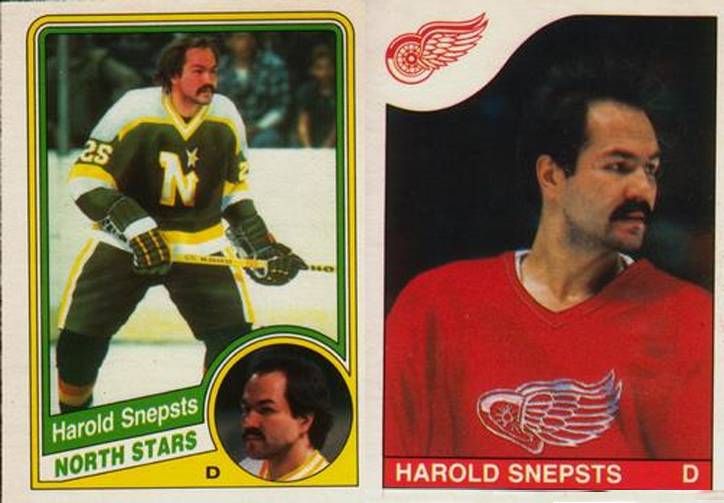
  Although somewhere along the way O-Pee-Chee and Topps lost their way.  Snepsts was traded to the Minnesota North Stars in 1984 and then signed as a free agent with the Detroit Red Wings in 1985.  Snepsts received the dreaded airbrush treatment in back-to-back sets before taking a hiatus until the 1989-90 OPC set.

1984-85 OPC and 1985-86 Airburshed Harold Snepsts
  So I decided to rectify the situation and reskin the 1984-85 and 1985-86 OPC cards.  While I was doing it, I considered how Snepsts switched teams during the offseason, so I made a design for the teams Snepsts player for the previous season, and the team he began the season with.

1984-85 OPC Harold Snepsts 1984-85 OPC Harold Snepsts
  During the 1984 off-season, the Canucks traded Snepsts to the North Stars straight up for Al McAdam.  McAdam would play a single season for the Canucks.  The following season, McAdam failed to make the Canucks out of training camp and would retire after playing a dozen games in the AHL.


1985-86 OPC Harold Snepsts

  Snepsts would lead the North Stars in PIM during his single season in Minnesota.  During the 1985 off season, Snepsts would be a free agent and signed a one-year deal with the Red Wings.

1986-87 OPC Harold Snepsts

  Snepsts' time with the Red Wings was plagued by injuries, as he only played in 120 regular season games during three seasons with the Wings.  What he did bring, was veteran leadership to a young Red Wings team, that included Steve Yzerman.  Snepsts best season with the Wings was 1986-87, in which he played 54 games and had 14 points.  So I would put his exclusion from the 1987-88 set as the most glaring omission during Snepsts time as a Red Wing, and thus the most deserving of a Lost Card.


1987-88 OPC #268 Harold Snepsts


1987-88 OPC #268 Harold Snepsts

  Snepsts would return as a free agent to the Vancouver Canucks for the 1988-89 season.  The following season the Canucks traded Snepsts to the St. Louis Blues, in a deal that saw Adrien Plavsic, who was 15 years Harold's junior, head to Vancouver.  The injuries continued to mount as Snepsts creeped up and played his 1000th career game on December 8th, 1990.  Snepsts retired at the end of the 1990-91 season with 1054 career games played.

Wednesday, August 7, 2013

TTM Success: Perry Berezan

  Perry Berezan scored one of the biggest goals in Calgary Flames history, and he did it while sitting on the bench.  Yes, we are talking about the Steve Smith own goal of 1986. 


You can see him on the bench at the 1:24 mark of the video on the bench.  Originally there was so much confusion, the refs gave the goal to Lanny McDonald.  It would be eventually correct and it was the game-winning goal in game 7 of the Smythe division final.  It was the only Stanley Cup the Oilers didn't win in a five year period.  Berezan was never able to crack the Flames line-up full-time and he was traded to the Minnesota North Stars at the 1989 trade deadline.  The Flames would go onto win the Cup that year.  Berezan would play a few seasons for the North Stars and then a few more for the expansion franchise, San Jose Sharks, before retiring in 1993.


Wednesday, March 20, 2013

TTM Success: JP Parise

 Jean Paul Parise was never really a star, but he put together an excellent career and was part of Team Canada in 1972 Summitt Series.  Parise will be best remember for his actions in Game Eight of the Summitt Series.  After Team Canada is called for three minor penalties within the first 5 minutes, Parise threatens the referee, Josef Kompalla, with a overhand swing of his stick.  Pairse was given a game miscount for his actions.  Kompalla, USSR's choice for game 8 referee, was a late change after one of the planned officials, Rudolf Bata, got ill with food poisoning.  In game Six, Kompalla had called Team Canada for 31 PIM compared to USSR's 4.  Conspiracy theories had USSR giving Bata food poisoning so their choice of officials would call the game.  After the Parise incident, Kompalla actually called more penalties against the USSR than Canada.  Did Parise's outburst help Team Canada win?  It definitely changed the game.


Tuesday, March 19, 2013

TTM Success: Neal Broten


  Neal Broten is a member for the US Hockey Hall of Fame.  He was part of the Miracle on Ice team that shocked the hockey world by beating the USSR and winning Gold in the 1980 Olympics.  Teammate Ken Morrow would win a Stanley Cup a few months after the Olympics, Broten would have to wait 15 years before becoming the only other Miracle on Ice player to also win a Stanley Cup.  In the process, he became the first American born player to score a Stanley Cup wining goal.

Thursday, January 24, 2013

1981-82 OPC Reboot - North Stars and Canadiens

Minnesota North Stars

   The North Stars had made it to the Stanley Cup Finals in 1981.  They were the underdog in each series.  Minnesota knocked off the Bruins, Sabres, and Flames, before being losing to the New York Islanders.  The North Stars only used two goalies the entire season.

Rk           Player Pos Age GP  W  L T/O  GA   GAA SO  MIN
1       Don  Beaupre   G  19 44 18 14  11 138  3.20  0 2585
2    Gilles  Meloche   G  30 38 17 14   6 120  3.25  2 2215
         Team Total          80 35 28  17 258  3.23  2 4800

1981-82 OPC #159 Don Beaupre (RC)

  Don Beaupre was a teenage rookie in 1980-81.  He played in the 1981 All-Star game and might have made the All-Rookie Team, if it had been invented yet.  1982-83 was the first season for the All-Rookie Team.  Don would have a lengthy career, lasting 667 games. 


1981-82 OPC #165 Gilles Meloche

  Gilles Meloche came to Minnesota as part of the merger with the Cleveland Barons. With both the Barons and North Stars struggling financially, the NHL merged the two teams and a dispersal draft was held.  I guess the NHL didn't want this new Barons-North Stars franken-team to be too powerful.  Meloche was one of the 12 players protected by the North Stars.  The following season, the North Stars improved to 68 points, a 23 point increase form the previous season.  Meloche retired in 1988, falling one loss short of the NHL career loss record at that time.  Meloche had 15 OPC cards, with only five including his mask.  His first eight cards were poses or warm-up shots.

Montreal Canadiens


   1980-81 was the Canadiens second season after Ken Dryden retired.  It finished like the first one, a dominant regular sesaon but with an earlier than expected play-off exit.  Although it couldn't be blamed on the goaltending.  The Canadiens goalies won the Vezina Trophy.  It was the last time the Vezina Trophy was awarded to the goalies who played on the team with the lowest goals against.  It was also the only time three goalies who had played for the same team shared the award.  It was also the only time a goalie, Michel Larocque, shared the trophy after being traded.  The following season, the William Jennings Trophy was introduce as the award for goalies on the teams with the lowest GAA.  The Canadiens goalies won it that season as well. 


Rk            Player Pos Age GP  W  L T/O  GA   GAA SO  MIN
1    Richard  Sevigny   G  23 33 20  4   3  71  2.40  2 1777
2    Michel  Larocque   G  28 28 16  9   3  82  3.03  1 1623
3       Denis  Herron   G  28 25  6  9   6  67  3.50  1 1147
4       Rick  Wamsley   G  21  5  3  0   1   8  1.90  1  253
          Team Total          80 45 22  13 228  2.85  5 4800


1980-81 OPC #191 Richard Sevign
  For all the success the Canadiens' goalies had, OPC only gave one of them a card.  One crummy card.  Although Larocque would get a "Now With.." treatment later in the set.  Richard Sevigny would have been Beaupre's competition for the All-Rookie team.  Sevigny led the league in GAA.  Sevigny played all three games in the Canadiens first round sweep at the hand of the Edmonton Oilers.  The following season he found himself on the outside looking in as another rookie Rick Wamsley led the Habs to a William Jennings trophy and another first round exit.

Bonus Canadiens

1981-82 OPC Denis Herron

  Denis Herron only played three seasons with the Montreal Canadiens.  He had two amazing seasons, with one mediocre one sandwiched between them.  Herron came to the Canadiens via trade with the Pittsburgh Penguins in 1979.  Herron played spectacular, he was 2nd in GAA and his 25-3-3 record is one of the best single season winning percentages for a goalie who played more than 25 games.  He slumped in 1980-81 with a 3.50 GAA, but the following season in 1982-83, Herron led the league with a 2.64 GAA.  The Canadiens traded Herron back to the Pittsurgh Penguins before the 1982-83 season for a 3rd round pick.  That 3rd rounder was later involved in the largest trade ever.  A trade that saw two players and nine draft picks change hands.

1980-81 OPC Rick Wamsely (RC)
  Rick Wamsley had an excellent start to his career.  He was 3-0-1 in five games in 80-81 and in 81-82, he went 23-7-7 and finished second in the league in GAA.  Wamsley was part of the trade that sent Brett Hull from Calgary to St. Louis.  Hull would go on to be a superstar with the Blues, but Wamsley helped the Flames win a Stanley Cup in 1989.

Friday, February 3, 2012

TTM: Dainel Berthiaume

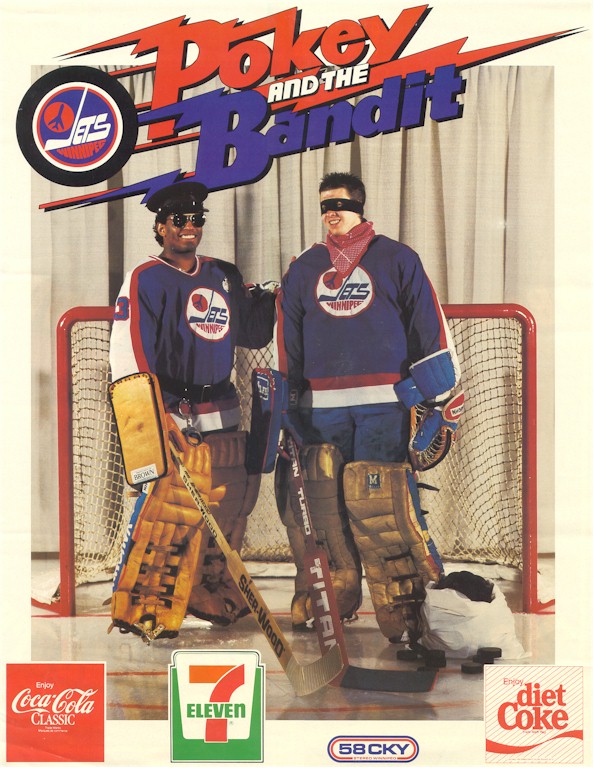
Daniel Berthiaume was one half of the Pokey and the Bandit netminding tandem for the Winnipeg Jets in the late 1980s.  Daniel would play 215 NHL games while playing for 5 franchises over 8 seasons.  He wore a different number with each team.  Berthiuame has traded in his goalie mask for a fisherman's cap as Captain Bert is now a professional fishing guide.

Monday, November 28, 2011

TTM: Basil McRae

3 card return from Basil McRae, all signed with ballpoint pen.  It's hard to be disappointed with any auto you get TTM but they are a lot nicer when signed with a sharpie.  I have read of some TTMers sending a sharpie along with their items, LOR and SASE.  Basil McRae currently runs a Financial Services Firm in London, Ontario.
Sent: November 3rd, 2011
Received: November 23rd, 2011


Tuesday, November 22, 2011

TTM: Don Beaupre

  This return from Don Beaupre was sent out October 26th and was received November 21st.  It was sent to his home but the postmark on the return envelope was from his business address.
  Beaupre spent the majority of his career with the Minnesota North Stars and the Washington Capitals before finishing his career with stints in Ottawa and Toronto.
  Mr. Beaupre signed both cards and a 4x6 for me.  He kept the extra copy of the 4x6.  It is just as exciting to have a player keep a custom as it is to get it back signed.

Sunday, September 25, 2011

88-89 OPC Tribute: Toews, Perry and Modano

#32 - Jonathan Toews


  The 3rd overall pick in the 2006 entry draft, Jonathan Toews, had an incredible 2009-10 season.  First he won an Olympic Gold Medal and then he won the Stanley Cup, as well as the Conn Smythe Trophy.  While 2010-11 didn't bring the same kind of team success, Toews set a personal best for points with 76.


#33 - Corey Perry


  Corey Perry not only looked like monster is 2010-11, he also played like one.  Perry won the Hart Trophy as league MVP and also won the Maurice Richard Trophy as top goal scorer.  Perry finished the season strong by scoring 19 goals in his final 16 games to vault himself into the goal scoring lead and he hit 50 in style by netting a hat trick.
  Perry's tear helped Anaheim to go 12-4-0 and to go from the outside looking in, to the #4 spot in the conference.


#103 - Mike Modano

  Mike Modano recently retired after a 21 year career.  He finished his career as 22nd on the career points list, with a total of 1374 points.  His 561 career goals is good for 23rd overall.  In 1999-2000, he was a key member of the Stanley Cup Champions, Dallas Stars.  Modano was also a member of the 1996 World Cup winning USA team, that shocked the Canada side and provide a new "Miracle on Ice" for a younger generation.
  Modano provided consistent production throughout his career, and was a lock for 80+ points for the majority of his career.  Modano never scored 100pts, and only once got 50 goals, but he lead his team in scoring 11 times over a 13 year stretch.
  Modano played 4 years with Minnesota, leading the team to the Stanley Cup finals before the team relocated to Dallas for the 93-94 season.  For this card, I had to have Modano in a Minnesota North Star.  It's actually the way I will remember him.


  There is no hockey legend for Mike Modano, perhaps in a few years there will be one.  Instead I will share this really well produced tribute video.

Thursday, September 22, 2011

10-11 Pinnacle Mike Modano Draft Card?

Is this a real card?  I saw this on the Panini Blog, The Knight's Lance but I can't find it anywhere else.  I didn't see it on eBay.  The card is shown on the right side of thier pages with the heading "Sweet Card" and the caption "The legendary Mike Modano Retires".  Was this card or insert set ever produced?  I have to agree, it is a sweet card.


The Legendary Mike Modano Retires