a img { display:none; } a:hover img { display:block; } -->
Showing posts with label Capitals. Show all posts

Thursday, July 16, 2020

Lost Rookies: 1985-86 OPC Geoff Courtnall

  Geoff Courtnall entered the NHL the same season as his younger brother, Russ.  Russ Courtnall was a 1st round draft pick of the Toronto Maple Leafs.  Geoff was undrafted and signed as a free agent with the Boston Bruins.  Geoff was the late-bloomer of the two.  Russ had more hype, but in the end, it is debatable who had the better career.
  Geoff signed with the Bruins in the 1983 offseason.  Although he had a rather uninspiring season with the Hershey Bears of the AHL, he did get called up and played 4 uninspiring games with the bruins in January.  
  He started the 1984-85 season with the Bruins.  In his first game, within the first minute, he got into a fight with Ray Neufeld.  He must have determined to make an statement to the club.  He scored his first career goal on October 21st, 1984 against Marc Behrend of the Winnipeg Jets.  On January 9, 1985, the brothers played each for the first time in the NHL.  The Bruins won 5-3, and bother brothers, Russ and Geoff, each scored a goal.  Geoff was a regular on the Bruins over the next three seasons, scoring about 15 goals and 35 points each year.

1986-87 OPC Russ Courtnall
  The 1987-88 season was Geoff's breakout year.  He moved his way up through the line-up and was eventually on the 1st line with Cam Neely and Ken Linseman.  He had 58 points in 62 games when he was traded to the Edmonton Oilers, along with minor league goalie, Bill Ranford, and a 2nd round pick to the Edmonton Oilers for Andy Moog.  Courtnall struggled with the Oilers.  He had 8 points in 12 games during the regular season, including a hat trick while playing on Wayne Gretzky's line, and only 3 points in 19 play-off games.  He didn't get much time on the top lines.  The Oilers were deep on the left-wing already with Glenn Anderson, Esa Tikkanen, and Mike Krushelnyski.  On the plus, side, Geoff won a Stanley Cup with the Oilers.

1988-89 OPC Geoff Courtnall
   It was a tumultuous summer in Edmonton during 1988.  The Oilers were a success on the ice, but the team wasn't paying owner Peter Pocklington's bills.  The cash-strapped owner made the infamous Wayne Gretzky trade, which included $15 millions dollars going to Pocklington's pockets.  A few weeks before that, the Oilers made another financial decision.  Geoff Courtnall was a restricted free agent and was looking for a raise.  The Oilers and Courtnall couldn't come to an agreement, so the New York Ranger made Courtnall an offer and he accepted.  As a restricted free agent back in 1988, the Rangers would owe the Oilers compensation for signing Courtnall.  It was basically a trade.  If the Oielrs and Rangers couldn't agree to the compensation, then a NHL official would decide.  For some bizarre reason, the Oilers traded the rights to Courtnall to the Washington capitals for Greg Adams (not the good Greg Adams, the other one).  The Capitals immediately matched the Rangers offer.  The Rangers filed a dispute with the NHL and then took the NHL to arbitration.  They lost both cases.
  Courtnall responded with a career season with the Capitals in 1988-89.  He scored 42 goals and 80 points.  It impressed Topps so much that they decided Geoff deserved to be a 2nd Team All-Star.  In reality, he had finished 4th in voting.  Geoff was finally rewarded with a rookie card.  Although I personally find the close-up headshot of Geoff to be one of the worst cards in the set.  First off, it's a head shot.  Secondly, it's the look on Geoff's face.  Lastly, it's the centering of the picture and the amount of dark space.  So while I was already doing Geoff Courtnall Cards, I decided to update his 89-90 rookie card as well.

1989-90 OPC Geoff Courtnall
   Geoff had a pair of good years while with the Capitals. 
  (After posting, I was enlightened to an incident that should be mentioned.  Courtnall's departure out of Washington was hastened by the Georgetown Limousine Scandal.  Three Capitals players, including Courtnall, were accused of rape by a 17 year old woman.  The District Attorney decline to lay charges in the incident but it made the front page in Washington.  Courtnall expressed disdain with the way he was treated by the press during the investigations.  He requested a trade out of Washington.)
  In the summer of 1990, the Capitals traded Courtnall to the St. Louis Blues for Peter Zezel and Mike Lalor.  Courtnall rode side-saddle to the Hull and Oates show in St. Louis.  He was traded at the 1991 trade deadline, along with three other Blues, to the Vancouver Canucks.  The trade would be considered one of best trades in Canucks history.
  It took a few season, but the Canucks made a run for the Stanley Cup in 1994.  The Canucks had six players they had acquired from the Blues in trades on their roster.  They also had Greg Adams, the good one.  Courtnall had four good seasons with the Canucks, including a pair of 70 point seasons.  In April of 1995, the Canucks traded for Geoff,s brother, Russ.  A few months later Geoff left the team as a free agent.
  Geoff returned to the St. Louis Blues for the 95-96 season.  During the 1997-98 season, Geoff suffered an eventual career ending concussion.  He missed four months during that season but returned for the play-offs.  After playing 6 games in 1999-00, Geoff retired due to post-concussion syndrome.
  Geoff eventually moved back to Victoria and now works in real estate and investing.  Geoff, and his brother Russ helped fund the Archie Courtnall Centre, a mental health facility in Victoria.  Geoff battled with alcohol after retiring. Geoff's father Archie also battled alcohol and depression.  Archie committed suicide in 1978, when Geoff was 16.  It took Geoff almost a decade to better his demons, and now he is committed to helping others.
  Courtnall never received had a rookie card until the 1989 atrocity.  Since his 83-84 season was a bust, I don't think he would have earned one until the 1985-86 season.  


1985-86 OPC #278 Geoff Courtnall (RC)

1985-86 COP #278 Geoff Courtnall (RC)


Thursday, January 23, 2020

Lost Cards: 1988-89 OPC Pat Riggin

  Pat Riggin was a Baby Bull.  In 1978 the Birmingham Bulls of the WHA in desperate need for players, and players on the cheap, signed six junior age players to their roster.  It was the final season of the WHA and the Bulls were not one of the teams to merge into the NHL.  The six junior players they signed would all be available in the NHL Entry draft, since no team held their rights.
  Riggin was the first goalie drafted in the 1979 NHL Entry draft, at 33rd overall to the Atlanta Flames.  Riggin played 25 games in his rookie season and also racked up a pair of shutouts, while playing behind Dan Bouchard (Lost Cards).  It was Riggin's only season in Atlanta, but not his final as a Flame.  The Flames struggled in the standings and financially, and the franchise was sold for a then record $16 million in 1980.  The new owners moved the team to Calgary and OPC responded by with a dreadful airbrush treatment of the entire team, colouring over the Flames logo on each card.  Riggin never got a card in the 80-81 set, so below is a card of Riggin as an Atlanta Flame.

1980-81 OPC Pat Riggin

  It did not take long for Riggin to takeover as the #1 goalie in Calgary.  He played 42 games in 1980-81 and helped the team make the Stanley Cup semi-finals.  He received a rookie card in the 198-82 set and although his card did not need it, he was part of my 1981-82 Goalie Reboot project. The following season Riggin played in 54 games, but the team was swept in three games in the first round of the play-offs by the Vancouver Canucks.  On draft day 1982, the Flames made a pair of deals to improve their crease.  They acquired two time All-Star Don Edwards (and previous Lost Card recipient) from the Sabres, and also traded Riggin to the Washington Capitals.
  The Capitals were going through a changeover themselves.  Riggin joined the team as the franchise began to focus on defence.  It paid off for Riggin as he led the league in GAA, 2.67, and shutouts, 4, in the 1983-84 season and also shared the William J Jennings trophy with creasemate Al Jensen.  Riggin was a Second Team All-Star and finished third in Vezina voting.  The following season, Riggin finished second in the league in GAA, 2.98.  With the exception of injuries, Riggin and Jensen were goalies 1A and 1B for the Capitals.  Riggin did end up on the short end of the cards, as Jensen was featured in the 1983-84 set but Riggin was left out.  Here's a 83-84 of Riggin for the Riggin fans.

1983-84 OPC Pat Riggin

  Although the Capitals played well and climbed the standings each season, they could not beat the New York Islanders in the play-offs.  They lost to the Islanders in three straight seasons, winning only 4 of the 14 playoffs games played between 1983 and 1985.  After bowing out in the 1985 play-offs, Riggin joined Team Canada at the World Hockey Championships, where he helped the team win a Silver medal.  In his first game, they defeated the U.S.A. and Riggin made some comments that were regarded anti-American.  In particular, he said he was "sick and tired of Americans coming to the NHL and taking our jobs."  Not the wisest of rants for a goalie playing in America's national capital and on a team that rostered the most American players in the league, including team captain, and two-time Norris winner, Rod Langway.  Riggin acknowledged the controversy in pre-season and stated "I am going to have to get off to an excellent start to get the fans behind me again."  Riggin did not get off to an excellent start.  In 7 games, he went 2-3-1, with a 3.75 GAA and a .826 save percent.  He was traded to the Boston Bruins for Pete Peeters.  OPC was not to press yet and Riggin got a "Now With..." card in the 1985-86 set.  His last card during his career.
  Riggin had a decent season in Boston but his stats fell a bit after leaving the defensive-centric Capitals.  Although he was the main starter throughout the year, he was benched in favour of rookie Bill Ranford after a game one loss in the play-offs.  The following season, Riggin found himself as the odd man out as the Bruins went with Ranford and Doug Keans (a previous Lost Rookie) between the pipes.  Somehow OPC must have seen the writing on the wall as Keans got a card in the 1986-87 set, but Riggin did not.  So in my quest to be the favourite blog of Pat Riggin fans, here's right to that wrong.

1986-87 OPC Pat Riggin

  As mentioned, Riggin found himself as the odd man out in Boston, and soon found himself out of Boston.  After being sent to the AHL, he was traded to the Pittsburgh Penguins in February of 1987 for goalie Roberto Romano.  Riggin played two seasons with the Penguins, posting respectable numbers, considering he played with the Penguins in the 80s.  Over two seasons, Riggin played 39 games, was 15-14-7 and had a 3.65 GAA.   Riggin was never able to takeover as the #1 goalie and was sent down to the AHL in Januray of 1988.  Riggin never returned to the NHL and retired at the end of the season.
  I have read that Riggin burned too many bridges while playing in the NHL, but the anti-american comment is only bridge I can find burned.  He was one of the top goalies in the mid-80s but put up average numbers outside Washington.  Riggin became a race horse trainer after retiring.  I previously had a TTM success with Riggin.  And now I present a Lost Card of Pat Riggin, a 1988-89 OPC.
  Hold on a sec.  I just noticed something about the stick.  Riggin uses a Wally goalie stick for the majority of his career, which you can see in the pictures above.  While he was in Pittsburgh, there are pictures of him using the Wally, but also pictures of the Louisville.  Also, the Penguins jersey made a minor change for the 1987-88 season, which was changing the collar on home jersey from black to gold.  You can compare the slight difference to this picture.  So based on the stick and jersey, I know I can find an actual picture from his final NHL season and thus best suited for the 88-89 card, although I would have preferred a higher res picture.  The original picture I was using, with Riggin in the black away photo, just looks older.  As well, the helmet looks different in the pictures, but the helmet used in his 87-88 OPC looks the same as the picture of Riggin in a home jersey with the black collar.  Although I could just ignore the difference and still used the older picture on the 1988-89 design.  OPC themselves often used, or reused, older pictures.
  So after a bit of editing, I made yet another Pat Riggin Card.  So including the 1981-82 reboot card, that's six I have done for Riggin.  I think I deserve an honorary spot in the Pat Riggin fan club by now.   So here's a 87-88 OPC and then the lost card of the 1988-89 OPC.  Do You think I made the right call in switching the pictures?

1987-88 OPC Pat Riggin

1988-89 OPC #271 Pat Riggin


1988-89 OPC #271 Pat Riggin


Thursday, January 9, 2020

Lost Cards: 1985-86 OPC Mike Palmateer

  The Popcorn Kid, Mike Palmateer, was an fan favourite in Toronto during his first tour of duty with the team, although his farewell tour did not go so well.
  Drafted 85th overall in the 5th round of the 1974 draft by the Toronto Maple Leafs, Palmateer made his debut on October 24, 1976.  Upon being called up, Palmateer reportedly told the Leafs "Your hunt for a goalie is over.".  Palmateer made good on his claim, winning his first three games and going 7-2-1, with 2 shutouts, including one against the Montreal Canadiens, in his first ten.  Palmateer became the Leafs goalie of choice.  Palmateer received a rookie card from OPC in the 1977-78 set but it was one of those helmetless inaction shots, so I put together an action variant for Palmateer.

1977-78 OPC Mike Palmateer

  In the 1978 playoffs, Palmateer's stellar play helped the Leafs upset the New York Islanders in overtime of Game 7.  The Leafs made it to the Stanley Cup semi-finals before getting swept by the Montreal Canadiens.  Mike continued to start for the Leafs but suffered an ankle injury in December of 1979.  He returned a month later, but re-injured his ankle ten minutes into his first game.  Afterwards, Palmateer claimed he felt rushed to return to action and was not actually ready to return.  It took another month before Palmateer played again.
  With his contract up after 1980,  Palmateer and Leafs could not agree on a new contract and were headed to arbitration, before Palmateer was traded to the Washington Capitals in a multi-player and draft picks deal.  Robert Picard, a previous Lost Card, was the key piece received by the Leafs.   The Capitals believed their search for a goalie was over.  In fact, Caps GM Max McNab, believed they would be "set in goalie for the next ten years."  Unfortunately, Palmateer's time with the Capitals was marred by injuries and only lasted two seasons.  Palmateer got a lame warm-up shot for the 1981-92 set, which I previously tackled during the 1981-82 OPC Goalie Reboot.  Palmateer played only 11 games during the 1981-82 season, his second with the Caps, due to injuries, and did not earn a card in the 1982-83 set.  Here's what a 1982-83 OPC Palmateer may have looked like.

1982-83 OPC Mike Palmateer
  There is a story regarding Palmateer leaving the hospital, where he was scheduled for knee surgery, since he was called in to fill-in for injured goalie Wayne Stephenson.  After the game, Palmateer returned to the hospital and had the surgery that week. Obviously, this would not be the type of decision that help prolong a career.  Although, I cannot find out when this actually was.  Stephenson and Palmateer were only teammates during the 1980-81 season.  The best guess I have is either December 17, 1980 or January 4th 1981.  Palmateer suffered a knee injury during a game against the Pittsburgh Penguin on December 12th.  Stephenson started the next game, but did not play again until January 4th.  I cannot find info on his injury.  Palmateer started all the games between Dec 17th and January 4th.
  On January 4th, Palmateer started, and injured his leg in the second period against the Philadelphia Flyers.  he was replaced by Stephenson, who finished the game.  Neither goalie played again until January 24 for Palmateer, and February 5th for Stephenson.  In the meantime, Dave Parro started 6 six games and Rollie Boutin started 2.  I would really like to find a newspaper article on this to confirm it.  Since it really is an incredible story.
  The contract Palmateer had signed withe caps put him into the upper echelon of NHL earners.  Frustrated with the returns on investment, and the Capitals abysmal on-ice performance, Capitals owner Abe Pollin basically cleaned house of the Palmateer deal, firing GM Max McNab, coach Gary Green and shipping Mike Palmateer back to the Maple Leafs for cash during the 1982 offseason.
  Palmateer, once again, ended the Leafs hunt for a goalie.  Although Leafs management was unimpressed as his play, as it was hindered by the numerous injuries he had incurred and had continued to suffer.  It didn't help that Palmateer had another contract dispute with the Leafs, winning a salary arbitration case after the 1983 season.  In the 1984 training camp, Palmateer and the Leafs brass once again had disagreements over his injuries.  Palmateer believed he should have rest days after games to heal up while the team felt he should have be back at practice the next day.  With youngsters Ken Wregget and Allan Bester poised to make the jump to the NHL, the Leafs felt Palmateer and his attitude should stay home.  After going unclaimed in the NHL waiver draft, the Leafs paid Palmateer to stay home.  They did not even assign him to the minors.
  In February of 1985,  the Edmonton Oilers contacted the Leafs about acquiring PalmateerGrant Fuhr had suffered an injury and the team was looking for a veteran to back-up Andy Moog while Fuhr healed.  Although the deal never materialized, Palmateer did attend the Oilers 1985 training camp, in which he played against the Leafs in exhibition play.  He never made the team and retired after being cut.
  If he had been traded, or had made the team, perhaps he would have had a place in the OPC set.  Highly unlikely, but he does land a spot on the Lost Cards.

1985-86 OPC #276 Mike Palmateer

1985-86 OPC #276 Mike Palmateer

Thursday, September 5, 2019

Lost Rookies: 1986-87 OPC John Kordic

  I had this post sitting in the draft folder for a few months now.  Originally I was going to try to write a very short bit on John Kordic. With each Lost Cards post, I try to do a recap of a player's career and highlight anything significant or interesting.  While Kordic's career was short, it was long on significant and interesting.  So even with the intentions on keeping it short, I ended up writing several paragraphs on Kordic, even before we had traded to the Leafs.  I made a decision, I was either going to write it all, or nothing, about John Kordic.  So I will write (almost) nothing.
  If you want to do more reading I suggest the Sports Illustrated's article Death of a Goon and the New York Times piece on his Funeral as starting points.  There was also a book written, John Kordic; The Fight of his Life, which had its movie rights purchased, although never filmed.
  I will say that I would love to see a movie on Kordic.  It's the Canadian Dream turned nightmare.  The price Kordic paid for success would lead to his demise.  Kordic and his father Ivan, were at odds over Kordic's role in the NHL.  His father loved hockey, but disapproved of Kordic fighting.  The death of his father in 1989 was the straw that broke the camel's back.  Kordic's downward spiral accelerated.  His play and attitude soured, and his substance abuse increased.  In August of 1992, Kordic, after an evening of alcohol and drugs, died of a heart malfunction after resisting arrest.  It is truly a tragic story.
  Kordic's rookie card was a 1990-91 OPC, as a member of the Toronto Maple Leafs.  He never had a card while with the Montreal Canadiens.  As a rookie, he won a Stanley Cup with the 1986 Canadiens, so I thought it'd be fitting to include him that's set.

1986-87 OPC #270 John Kordic (RC)

1986-87 OPC #270 John Kordic (RC)

  Since John would have preferred to be remembered for more than just his pugilism, here is another card of Kordic.


1987-88 OPC John Kordic

  While Kordic would have a card with the Quebec Nordiques, his final NHL team, his brief 7 game stint, and 101 PIM, with the Washington Capitals would go uncarded.  Below is what it could have looked like.

1991-92 OPC John Kordic


Wednesday, March 13, 2019

Lost Rookies: 1981-82 OPC Tim Tookey

  I have been sitting on this post draft for a few years.  Originally I was planning on sending this card out to get signed via TTM.  Maybe even try to score an interview.  The blog has been largely dormant for the past few years, so my original hopes of getting interviews are long gone.  Now I just wonder who actually read this.  Regardless, I still a few cards I haven't shared, and perhaps will make a few new ones as well.
  Tim Tookey was inducted to the Hall of Fame in 2008, AHL Hall of Fame that is.  A skilled offensive threat, Tookey was never able to secure a roster spot in the NHL.  He played in parts of seven NHL seasons while playing for five different teams.
  His best season came was his rookie season in 1980-81, in which Tim netted 23 points in 29 games.  The points and games were both career bests for Tookey.  Tookey had cups of coffee in Quebec, Pittsburgh, Philadelphia and Los Angeles, before retiring from professional hockey in 1995.  He spent the majority of his professional career as a Hershey Bear in the AHL.  In the AHL, Tookey topped 100pts in a season three times and was league MVP in 1987.
  A highlight in Tookey's NHL career came in a 10-4 victory over the Philadelphia Flyers on November 21, 1981.  Tookey, and teammate Denis Maruk, both recorded Hat Tricks in that game.
  Tim Tookey never had a NHL card.  Below is a custom 1981-82 OPC rookie card of Tim Tookey.


1981-82 OPC #398 - Tim Tookey (RC)

_______
Added July 11, 2021

  Although Tookey played for five different franchises, he played very few games with each during the 1980s, making quality pictures of Tim difficult to find.  I did find one of him as a Nordique, so here's another Tookey card.
1983-84 OPC Tim Tookey


Sunday, March 31, 2013

1982-82 OPC Reboot: Caps and Jets

Washington Capitals

  For the second straight season, the Washington Capitals missed the play-offs while finishing the season within two points of the final play-off spot.  The Capitals had the last spot secured as late as April 1st, before getting passed by the Toronto Maple Leafs, with three games left in the season.  The Leafs would finish the season with 71 points; the Capitals had 70.  The Capitals would have to wait until 1983 before making their debut in the Stanley Cup Playoffs.


Rk             Player Pos Age GP  W  L T/O  GA   GAA SO  MIN
1      Mike  Palmateer   G  27 49 18 19   9 172  3.85  2 2679
2          Dave  Parro   G  23 18  4  7   2  49  3.63  1  811
3    Wayne  Stephenson   G  36 20  4  7   5  66  3.92  1 1010
4         Gary  Inness   G  31  3  0  1   2   9  3.00  0  180
5       Rollie  Boutin   G  23  2  0  2   0  11  5.50  0  120
           Team Total          80 26 36  18 307  3.84  4 4800

1981-82 OPC #351 - Mike Palmateer

  After falling two points short of a play-off birth in 1980, the Capitals traded for Mike Palmateer, sending the Toronto Maple Leafs All-Star defenceman, Robert Picard.  Ironic, that the Caps would then lose out to the Toronto Maple Leafs on the final play-off spot.  Palmateer's time in Washington would be short.  In his second season with Washington, he suffered a season ending knee injury.  It probably didn't help that the Capitals once call upon a drugged up Palmateer off a hospital gurney, just prior to knee surgery, to play a game.  The Capitals would sell Palmateer back to Toronto.  He would retire two season later. 


Bonus Capitals

1981-82 OPC Wayne Stephenson

  Wayne Stephenson had a late start on his NHL career.  He was 27 before he signed his first professional hockey contract in 1972, even then it was only a 30 day trial contract, as Stephenson had a bigger dream in mind, an Olympic Gold Medal.  Stephenson had played with the Canada National team since 1966.  He played in 3 games in the 1968 Olympics, helping the team win a Bronze medal.  He was slated to the be the #1 goalie for the 1972 Olympics, until Canada pulled out of the Olympics and World Championships.  Canada protested that it could never win a Gold as long as Russia was allowed to use "professional amateurs".  Stephenson would start his career with the St. Louis Blues before getting traded to the Philadelphia Flyers, where he won a Stanley Cup  in 1975, as Bernie Parent's back-up.  He would spend his final two seasons in Washington, before retiring in 1981.

    
1981-82 OPC Dave Parro (RC)


    With injuries to starters Mike Palmateer and Wayne Stephenson, Dave Parro was made his NHL debut for the Washington Capitals.  His first career start was against the Edmonton Oilers, although the Caps lost, Parro took consolation in stopping Wayne Gretzky on breakway.  In his fourth career start, he earned his first career shutout versus the Los Angeles Kings.  Parro took over starting goalie duties in 1981-82 after Mike Palmateer re-injured his knee.  Although it was not to last, as another rookie goalie, Al Jensen, would upstage Parro in the later stages of the season.  Then during the offseason, the Capitals would trade for another goalie, Pat Riggin. Parro would be the odd man out, playing in only 6 games in 1982-83 and playing a single minute in 1983-84. 


1981-82 OPC Gary Inness

  From the 1976-77 season to the 1982-83 season, a different goalie led the Washington Capitals in games played.  During the 1978-79 season, it was Gary Inness who led the team with 37 games played.  The Capitals signed Gary Inness in December of 1978, after the Indianapolis Pacers of the WHA folded 25 games into their season.  Inness went 14-14-8, becoming the first Washington Capitals goalie to have a .500 or better record, with more than 1 decision.  This did not inspire any faith in him by the Capitals, as they traded for Wayne Stephenson before the start of the following season.  Inness would spend the majority of his time in the AHL the following two seasons before retiring in 1981.


1981-82 OPC Rollie Boutin (RC)

   Rollie Boutin had a strong 1980-81 campaign, in the AHL.  He led the AHL in wins, shutouts and was a Second Team All-Star.  His brief time in the NHL was not as strong.  Rollie failed to build on his 79-80 season, where he went 7-7-1, 3.50 with the Capitals.  He only played two games with the big team in 80-81 and allowed 11 goals in his two starts.  Boutin would bounce around the minors for a few more season before retiring in 1984.


Winnipeg Jets


   The Winnipeg Jets won the Avco Cup, the WHA's championship, in back-to-back seasons in 1978 and 1979.  They struggled in their first season in the NHL, in thier second season, they down right awful. They scored the least goals and allowed the most goals in the NHL.  They won their first game of the season on October 17th.  They didn't win another game until December 23rd, setting a NHL record with a 30 game winless streak.  They were a bad team.

Rk                Player Pos Age GP W  L T/O  GA   GAA SO  MIN
1        Markus Mattsson   G  23 31 3 21   4 128  4.50  1 1707
2           Pierre Hamel   G  28 29 3 20   4 128  4.73  0 1623
3            Michel Dion   G  26 14 3  6   3  61  4.83  0  757
4    Lindsay Middlebrook   G  25 14 0  9   3  65  5.97  0  653
5            Ron Loustel   G  18  1 0  1   0  10 10.00  0   60
              Team Total         80 9 57  14 392  4.90  1 4800

1981-82 OPC #365 Pierre Hamel

  Pierre Hamel was selected by the Jets from the Toronto Maple Leafs in the expansion draft.  Hamel had played in 5 games with the Leafs since 1974.  Hamel would last two seasons with the Jets before returning to the minor leagues to finish his career.


1981-82 OPC #374 Markus Mattsson

    When the Winnipeg Jets merged into the NHL from the WHA in 1979, they lost a lot of key players.  Most of its players had their NHL rights already owned by another team.  The Jets were allowed claim up to two skaters and two goalies as priority selections, if the NHL who held thier rights tried to claim them.  The Islanders, who drafted Mattsson in the 5th round of the 1977 amateur draft, attempted to claim Mattsson, but the Jets denied the Islander's claim on Mattsson by labeling him as a priority selection.  After playing two seasons for the Jets, Mattsson would spend the entire 1981-82 season in the minors before signing as a free agent with the Minnesota North Stars in the following offseason.  Mattson was the Winnipeg Jet goalie to record a shutout in the NHL.

Bonus Jets


1981-82 OPC Michel Dion

    Michel Dion's season actually improved after being sold to the Winnipeg Jets in February of 1981.  While he was a Nordique, Dion was 0-8-3, 5.32 GAA in 12 games.  As a Jet, Dion was 3-6-3, 4.83 GAA in 14 games.  The three wins tied him for the team lead in that category.  He would leave the Jets via free agency to sign with the Pittsburgh Penguins.  He had his best season of his career the following year and played in the 1982 all-star game.  This is Dion's second card in the reboot, as I gave him an update card as a Penguin.


1981-82 OPC Lindsay Middlebrook (RC)

  Lindsay Middlebrook had a lot of success in the minors, winning a Turner Cup and twice being named to the 1st or 2nd All-Star team, but in the NHL, he had very little success.  Middlebrook was picked by the Jets in the 1979 expansion draft after the New York Rangers left him unprotected.  In two seasons with the Jets, Middlebrook went 2-17-3, 5.11 GAA.  He would later have stops with the Minnesota North Stars, New Jersey Devils and Edmonton Oilers.  It was with the Edmonton Oilers he had his most success, going 1-0-0, 3.00 GAA.


1981-82 OPC Ron Loustel (RC)

  One game, ten goals against.  That is the NHL career of Ron Loustel.  On March 27th, 1981, Loustel, recently called up from the Saskatoon Blades of the Western Hockey League, got the call to start in net against the Vancouver Canucks.  For whatever reason, coach Mike Smith left Loustel inbetween the pipes for the entire 60 minutes and 10 goals.  To Loustel's credit, the Jets defence was atrocious that net, allowing Vancouver to get 51 shots on net including 20 in the final period.   Loustel would return to the junior leagues the following season.  He only play one more professional game.  He allowed 3 goals in 33 minutes with the Fort Wayne Comet of the IHL.
  It'd be interesting to see why the Jets started Loustel and then kept him in for all ten goals.  The previous game was on March 22nd, so the team had five days to decide on who to start.  Loustel was born in Winnipeg, so that might have contributed to the decision to start him at a home game, but why leave him out to dry? 

Wednesday, February 20, 2013

TTM Success: John Slaney

  John Slaney had a long professional career, albeit mostly in the AHL.  He played in 1124 games in 20 professional seasons, but he will best be remembered for a single moment before his pro career began; The Slaney Goal.  Before the influx of Eastern Bloc players in the early 1990s, it was only once every 4-5 years when the best players from Canada and Russia would face-off.  In between those years, it was at the World Juniors Hockey Championships where the two countries would battle for hockey supremacy.  January 4th, 1991, Canada versus Russia.  It was only a round robin game, but considering the standings, the winner would get Gold, or in Russia's case, a win or a tie for Gold.  With the score tied 2-2 and a little over 5 minutes remaining in the game, John Slaney picked off a clearing attempt at the blue line in the Russian zone and wired a slapshot past the Russian goalie.  The goal would clinch Canada's first ever back-to-back Gold medals in the tournament.  Slaney would go on to play 268 NHL games over 9 seasons with 7 different franchises.  He did find success in the AHL, setting a record for career points by a defenceman, since broken.  While Slaney never found the NHL success that was expected of him, he did have a very long pro career and will always be remembered for the Slaney Goal of 1991.


Saturday, February 9, 2013

TTM Success: Jack Lynch


  Jack Lynch spent his career on some fairly bad teams, but no team rivals the 1974-75 Washington Capitals.  Traded midseason from the Detroit Red Wings to the Capitals, Lynch would play 20 games for Washington in 1974-75, scoring six points and registering a minus 52.  Based on his 20 games with the Caps, Lynch would have been on pace for -216 if he had played the entire season with the team.  The following season was a better one for Jack and the Caps.  The Caps won 11 games, up from eight the previous season and Lynch improved to a -52.  Unfortunately for Jack, his career ended due to injuries in 1979 before the Capitals started to be a competitive team.  He added a post-it note on the card on the right, pointing out that the player on the card is not him, but teammate Bill Collins.  Jack currently works for Ontario Tourism.


Wednesday, October 31, 2012

TTM Success: Doug Jarvis


  Doug Jarvis holds the record for the NHL's longest consecutive game streak.  He never missed a regular season game in his career.  He played in every game from October 9, 1975 to October 10th, 1987.  Jarvis, then with the Hartford Whalers, was scratched in the 3rd game of the season.  He never played again in the NHL.  He was demoted to the AHL later in the year and retired after 24 games.  Jarvis filled his trophy case during his playing days, winning four Stanley Cups, a Franke Selke trophy, a Masterson trophy and a Bronze medal in the inaugural, but unofficial, 1974 World Junior Hockey Championship.  Jarvis won two more Stanley Cups as an assistant coach,  Dallas in 1999, and Boston in 2011.


Monday, October 15, 2012

TTM Success: Bill Mikkelson


 Bill Mikkelson played 141 career NHL games and was a player I had never heard of until reading a where are they now article in Sports Illustrated.  Mikkelson was part of the 1974-75 expansion team, the Washington Capitals.The 1974-75 Caps set NHL records for worst winning percentage, .131, and goals against in a season, 446.  They set a modern day NHL record with fewest points in a season with 21.  While some of those team records will likely never be broken, Bill Mikkelson set a record that's considered unbreakable.  While playing in 59 games, Mikkelson was a -82. To put that in perspective, only a single player has a lower +/- when combining all seasons since the lockout.  Jack Johnson is -85 in 364 games.  Since 1994-95, the first lock-out season, only four players have gone below -40, with Rico Fata topping (or is it bottoming?) that list with a -46. 
  Mikkelson is not alone on the list of worst single season +/-,  spots 2, 3, and 4 all belong to teammates from the 74-75 Caps.  Greg Joly was a -68 in 44 games, and Jack Lynch, a last season acquisition, was -54 in 20 games with the Capitals.  If Lynch had played all 80 games with Caps, that projects to a -216 for the season!!!  As mentioned in the SI article, Bill Mikkelson's single season worst +/- might just be a truly unbreakable record.  Mikkelson's attitude remains positive about the experience.  It is better to have played and been scored upon (lots) than to have never played at all.  "I got to play. And the price I paid, I would pay it 100 times over." He has also fathered a NHL defenceman, Brendan, and a Olympic Gold medal winning defencewoman, Meaghen.


Friday, July 13, 2012

TTM: Pat Riggin

Pat Riggin won the Williams J Jennings trophy and was a 2nd team All-Star in 1983-84, when he lead the league in shutouts and GAA.  Riggin played with four teams (Flames, Capitals, Bruins, and Penguins) in career, but had his best seasons with the Capitals.  The Capitals finished in the top 5 for least GA each season in which Riggin played a game for them.  Riggin played in the 1985 World Championships for team Canada.  
Mr. Riggin signed 3 of 3 care of home.  He liked the custom picture so much, that he asked for more copies.


Sunday, July 8, 2012

200 and 30 Club: 2011-12 Season

The 200 hits and 30 goals club was very exclusive club in the 2011-12 season.  It's membership was limited to one man...  Alexander Ovechkin.


  Ovechkin, who set career lows in points and ice-time, finished with 38 goals and 215 hits.  After the season he was voted to be the worst local athlete by readers of The Washingtonian magazine.  Don't worry Alex, the 200-30 club still welcomes you.  Ryan Callahan ended the season one goal shy of making the club.  He missed 6 games last season and at one point, was on pace for the 300-30 club.  A few other players made a run at 200-30, but fell short.


  For Ovechkin, he has now made the 200-30 club fours times in his career.  More than any other player since Hits became an official NHL stat in the 2005-06 season.


Thursday, June 14, 2012

TTM: Bob Mason

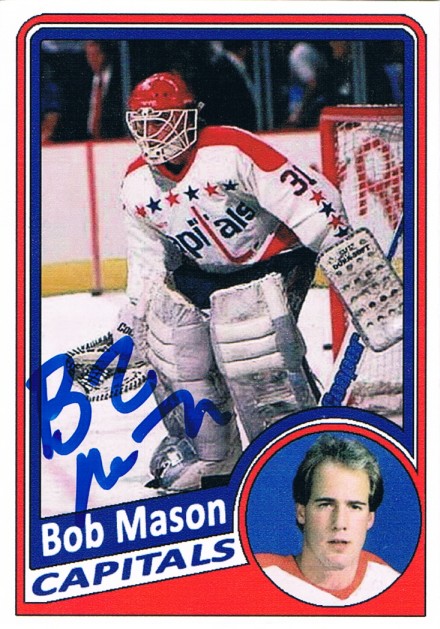
I featured Bob Mason and this card on a previous edition of The Forgotten and you can read that story here.  The key part of that post was to mention that Bob Mason never had a NHL card produced until 2004, 14 years after his last NHL game.  So I made up a rookie card, complete with the back, and I mailed it off to him in hopes of him keeping one and returning the other signed.  My success rate was 50%.  Mr. Mason signed and returned both copies of the card, and both copies of the 3.5x6.  The 3.5x6 was the same picture, just bigger.  While I am excited to get this back, I am also a bit disappointed that he never kept a copy.  Although I wonder how many times he has been sent a custom card of the 84-85 OPC set.  Considering quality Bob Mason pictures are rare on the web, I wouldn't be surprised if he seen this card several times before.


Sunday, June 10, 2012

TTM: Sergei Gonchar

  Sergei Gonchar established himself as one of the top offensive threats from the blueline at the turn of the century, aka year 2000.  Gonchar scored the 2nd most points, 504, by a defenceman from the 1999-2000 season to 2008-09.  Gonchar's point production has dropped off since signing with the Ottawa Senators as a free agent in 2010.  Gonchar has recently been mention in several trade rumours, such as being sent to Philadelphia, as the Senators try to cut costs while opening the vault to resign RFA and fellow blueliner, Erik Karlsson.  Mr. Gonchar signed 3 of 3 and actually signed in the signature box on the custom picture.  Thank you, Mr. Gonchar.


Sunday, March 18, 2012

TTM: Mike Gartner

  Mike Gartner scored 30 goals or more in a record 15 consecutive seasons.  Gartner is one of 6 players to score over 700 goals in a career.  He finished his career with 708 goals and 1335 points, which helped him earned membership into the HHOF in 2001.  Gartner was never able to find post-season success.  The closest he got was 1994 with the Toronto Maple Leafs.  The Leafs lost in the Stanley Cup semi-final.  Gartner was a trade deadline acquisition from the eventual Stanley Cup Champions, the New York Rangers.  Mike Gartner holds the record for most career games played, 1432, without ever playing in the Stanley Cup Finals.  Today, Gartner is an active volunteer and owns a few hockey rinks in the Toronto area.
Mr. Gartner signed 3 of 3 c/o National Training Rinks in 37 days.  Thank you Mr. Gartner.


Monday, March 12, 2012

TTM: Pete Peeters


Pete Peeters had one of the greatest seasons by a goalie ever in 1982-83.  Peeters won 40 games, had 8 shutouts and a GAA of 2.36.  That's a 2.36 GAA during the highest scoring era of NHL history, and it is also the lowest GAA for a single season in the 1980s.  Peeters would finish in the top ten in GAA nine times in his 13 year career and lead the league twice.  Peeters finished his career with 246 career wins and a 3.08 GAA, which is a damn good number for a goalie from the 1980s.  Peeters played for Team Canada in the 1984 Canada Cup.  Unfortunately for Mr. Peeters he will live infamously through the highlight reel as Bobby Nystrom scores the Stanley Cup winning goal in overtime for the 1980 New York Islanders.
Mr. Peeters signed 4 of 4 in 30 days care of the Anahiem Ducks, where he is a goaltending coach.


Friday, January 13, 2012

TTM: Mike Ridley

  Mike Ridley scored 758 points in 866 NHL games.  His best season was 1988-89 when he scored 41 goals and 89 points.  One thing Mike Ridley didn't do enough of was take shots.  Six times in his career he had a shooting percentage over 20% and his career mark of 19.3% is good for 10th all-time.
  My first attempt to Mr. Ridley was a RTS, but my second attempt scored 2 of 2, in 21 days.