a img { display:none; } a:hover img { display:block; } -->
Showing posts with label Jets. Show all posts

Thursday, July 23, 2020

Lost Rookies: 1983-84 OPC Brian Hayward

 Brian Hayward was part of the NHL's best one-two goalie punches in the late 80s.  Brian was the 1B to Patrick Roy with the Canadiens, but that wasn't enough for Brain, he wanted more.
  Hayward didn't play junior hockey, instead he played with Cornell University in the NCAA.  Like most college players, he went undrafted.  He signed as a free agent with the Winnipeg Jets in the summer of 1982.  Brian was called up in January and pushed incumbent back-up Ed Staniowski to the minors.  It took Hayward a bit longer to gain the #1 spot in the crease.
  As the Jets broke training camp in 1984, they traded away incumbent #1, Doug Soeteart to the Montreal Canadiens.  The Jets started the season with Hayward, and fellow 24 year old, Marc Behrend.  They split games early on, as Behrend was hot, but as he cooled, Hayward took over.  Hayward finished second in the league with 33 wins and was 5th in Vezina voting.  He ended the season on a personal 12 game unbeaten streak, going 10-0-2, .902, and 2.86.  It was good enough to get a headshot in the 1985-86 set.  Although, I feel the front of the card needed an upgrade.

1985-86 OPC Brian Hayward

  He followed that up with a dud.  In the 1985-86 season, Hayward went 13-28-5, .843, and 4.80.  In four seasons, Hayward's GAA went from 3.71 to 4.87 to 3.83 to 4.80.  Sensing inconsistency, the Jets traded Hayward to the Montreal Canadiens for another struggling goalie, Steve Penney.  OPC caught the trade in time to have Hayward in his Canadiens uniform and matching headband for the 86-87 set
  Hayward joined rookie sensation, Patrick Roy, in Montreal and the duo became the elite goalie pairing of the late 1980s.  They played a time share but both wanted to be number one.  The competition between them helped the duo capture three consecutive Jennings trophies.  In his first season with the Canadiens, Hayward led the NHL with a 2.82 GAA.  In his first three seasons with the Canadiens, he finished in the top five for GAA each season.  Hayward was even the Canadiens goalie in the 1987 play-offs after Roy got blown out in Quebec.  OPC had Hayward in warm-up gear for most of his OPC cards with the Canadiens, so I made a reskin for his 87-88 OPC.

1987-88 OPC Brian Haywrd

  Although the pairing worked great for the Canadiens, it was not always amical.  Hayward and Roy both wanted to be the starter.  They were also roommates.  There are stories of Hayward staying up late at night watching TV on the evenings before Roy was scheduled to start, but early to bed on the nights he was scheduled.  Implying Hayward was not above dubious tactics to get the edge on Roy.  As the season progressed, Roy continued to improve and became the main starter in the play-offs.  Roy won the Vezina in 1989 and during the 1990 season approached coach Pat Burns and made a case to be the clear  #1 starter.  Roy also petitioned and got himself a new roommate.
  Up until Feb 1st, Roy had started 29 games compared to Hayward's 25.  Roy was 16-11-2, .907 and 2.64.  Hayward was 10-10-4, .883, and 3.20.  For the rest of the season, Roy started 23 games, and Hayward 4.  Roy's play improved once was the clear #1, enough so he won his second consecutive Vezina trophy.  It was also the only season that the Hayward-Roy combo did not win the Jennings trophy.
  The time share was over and Hayward knew we he was no longer goalie 1B for the Canadiens.  Hayward.  Roy started the 1990-91 season firmly entrenched as the teams #1 goalie.  Hayward responded by going home and demanded a trade.  He claimed the Canadiens promised him a shot at playing half the games and that team had reneged.  Brian firmly believed he was #1 goalie quality and wanted the chance to show it.  It took a month into the season before Hayward was traded to the Minnesota North Stars for Jayson More.  Unfortunately for Hayward, North Star incumbent Jon Casey was not going to give up the crease so easily.  Hayward was once again on the wrong side of a 1A-1B platoon.  Even worse, Casey took over in the play-offs and led the team to a surprising Stanley Cup finals run.
  A bit of hockey oddity, the Minnesota North Stars became two teams after the 1991-92 season, the Minnesota North Stars and the San Jose Sharks.  Although only a handful of NHLers would be dispersed to San Jose.  Brian Hayward was left unprotected by the North Stars and he was selected by the Sharks in the dispersal draft.  Later that day,  the defending Campbell Conference champs North Stars, and the Sharks participated in an expansion draft.  In that draft, the Sharks selected Jayson More third overall.  An odd twist to the Hayward-More trade tree.

1992-93 Fleer Ultra Brian Hayward

  Hayward stunk in San Jose.  Part of this was due to a back injuries which cost him most of the 91-92 season and ended his career in 92-93.  Part of this was due to the Sharks stinking.  In his second season with the Sharks, and last in the NHL, Hayward posted a 2-14-1, .856 and 5.55 stat line.  His save percentage and GAA were worst in the league for goalies with 10+ games played.  He retired after the 1992-93 season.
  Hayward had a single card as a Jet.  He procured a rookie card in the 1985-86 OPC set.  Let's jump a few years ahead and give Hayward a rookie card in the 1983-84 OPC set.

1983-84 OPC #398 Brian Hayward (RC)

1983-84 OPC #398 Brian Hayward (RC)

/


Thursday, October 24, 2019

Lost Cards: 1986-87 OPC Jimmy Mann

  I am not sure why, but for some reason I equate Jimmy Mann to being the ultimate draft bust.  Mann was the first player ever selected by the Winnipeg Jets in a NHL Entry draft.  The Jets joined the NHL after the WHA folded, and lost many of their stars to NHL teams, who had owned their NHL rights.  The Jets got to restock via an expansion draft but Jets and the other ex-WHA teams were shuffled to the end of the draft order for the NHL Entry Draft.  The Jets got the 19th overall pick in the 1979 draft and selected Jimmy Mann of the QMJHL's Sherbrooke Canadiens.
  It's odd that I considered a player selected 19th overall, who played over 200 career games, the ultimate draft bust.  It's true that the next two players selected were Michel Goulet and Kevin Lowe.  It's true that Mann's 30 career points is about 130 less than the second lowest total of players drafted in the first round.  It's true that Mann is only one of two players selected in the first round that played less than 590 career games.  Although it's also true there are many players in other drafts years selected higher than 19th overall whom never played a single game in the NHL.  So I really have no idea how I equated Jimmy Mann as the ultimate draft bust.  It's a notion that formed as a child and I can't remember why.
  Mann put up some decent numbers in junior to backup his high draft position.  He had back-to-back 80+ points and 260 PIM with the Sherbrooke Castors.  He was a QMJHL First Team All-star in 1979 and had 14 goals and 26 points in 12 play-off games.
  Mann joined the Jets for the 1979-80 season.  He scored his first career goal against Curt Ridley of the Vancouver Canucks.  It was a powerplay goal and the game winner in a 5-3 victory.  It was the last time he scored a powerplay or game-wining goal in his career.  Mann led the NHL in PIM, 287, during his rookie season.  Mann had career highs across the board in his rookie season with 3 goals, 5 assists, 8 points, and 287 PIM in 72 games played.  In his second season, Mann led the Jets in PIM, 105, while playing in 37 games.
  Mann would become infamous in 1982.  On January 13, 1982, Mann sucker punched Paul Gardner.  Gardner missed 21 games due to a broken jaw.  Mann was suspended 10 games and charged, and convicted of assault.  At the time, it was one the sixth longest suspension in NHL History.  Gardner had earlier cross-checked the Jets Doug Smail in the face.  In retaliation, Jets coach, Tom Watt, send Jimmy Mann over the boards to send Gardner a message.
  Mann's reputation was tarnished as he had gone from prospect to enforcer to goon.  Mann spent another season and a half with Jets, scoring one goal, 2 assists and 134 PIM in 68 games after the incident.  He was sent down to the minors in November of 1983 and stayed there until he was traded to the Quebec Nordiques for a 5th round draft pick.  Mann would be used sparingly with the Nordiques.  Although part of the team, he was not dressed during the infamous Good Friday brawl between the Nordiques and Canadiens in the second round of the 1984 play-offs.
  Mann suffered a serious abdominal injury in December of 1984.  He returned to the team late in the season but the injury nagged him for the next few seasons and was severe enough for him to miss the entire 86-87.  Mann signed as free agent with the Pittsburgh Penguins for the 87-88 season.  It was an injury plagued season as Mann missed time due to elbow and groin injuries.  He accumulated 53 PIM in 9 games the Penguins and also 61 PIM in 10 games in the minors.  After spending the 88-89 season in the minors, Mann retired.
  Certainly looking back, Mann did not live up to his potential but I also feel he doesn't live up to my labeling him as the ultimate Draft Bust.  There are some top 10 picks who never played a NHL game and plenty of top 5 picks never played a full season.
  Mann's career in cards turned out to be a bust.  After getting cards in his first two seasons, the 80-81 and 81-82 set, Mann disappeared from OPC.  Mann took notice of this and actually blamed Alan Eagleson, NHLPA head and agent for Paul Gardner, for blackballing him from the hockey sets.  The story is also covered in Hockey Card Stories.  I agree that Mann was not cardboard worthy after the 81-82 release, but that's where I come in.  I couldn't find a decent picture of Mann as a Penguins so his Lost Card will be him as a Nordique.

1986-87 OPC #275 Jimmy Mann

1986-87 OPC #275 Jimmy Mann

  Update 12/15/19:  Bonus Mann
 
1982-83 OPC Jimmy Mann

Thursday, July 4, 2019

Lost Cards: 1980-81 OPC Gary Smith

  Gary "Suitcase" Smith was well known for being a "character" and for being on the move.  He earned the nickname "Suitcase" even before he played a season in the NHL.  The Toronto Maple Leafs were already set in net with veterans and future Hall of Famers, Johnny Bowers, and Terry Sawchuk, as well as another top prospect in Gerry Cheevers.  So Gary found himself bouncing around the minors in 1964-65, as well being loaned to the Boston Bruins as a back-up.
  Smith would see his first NHL action the following season, 1965-66.  Gary started, and lost, against the New York Rangers on February 19th, 1966.  Over two seasons, Smith would play in five games for the Leafs, going 0-4-0, 3.62.
  As a member of the Toronto Maple Leafs franchise, Smith's antics included attempting to punt the puck up into the scoreboard and stickhandling the puck into the opposition zone in an attempt to score a goal.  Smith inspired a NHL rule change that would penalise goalies if they attempt to cross centre ice as part of the play.
  Gary was left exposed in the 1967 NHL expansion draft and was selected as the 11th goalie in the draft, by the California Seals.  Smith would overtake veteran Charlie Hodge by the Seals sophomore season in the NHL, and by the 1969-70 season, Gary was a league leader... in losses.  To prove it was no fluke, Gary not only led the league in losses in 1970-71, but set a NHL record by losing 48 games.
  OPC was fairly brutal to Gary during his playing days.  No offense Gary, I am sure the ladies appreciated your cards, but your card career was full of mug shots and photo day poses.  Only the 1977-78 OPC comes close to pleasing to goalie card aficionados.  So for a bonus, I'll update a few of Gary's OPC card fronts with action shots.

1970-71 OPC Gary Smith

  For the 1971-72 season, Gary Smith went from the doghouse, the last place Oakland Seals, to the penthouse, the West division top team, Chicago Black Hawks.  Smith followed up his record setting season in futility by sharing the Vezina trophy with Tony Esposito.  Smith had 5 shutouts in 28 games for the Hawks on 1971-72.

1972-73 OPC Gary Smith

  After another season backing-up Tony Esposito, Smith was traded to the Vancouver Canucks.  Where he promptly led the league in losses for the third time in his career.  The 1974-75 season saw a re-alignment of divisions and the Canucks thrived in the newly created Smythe division, finishing first.  Smith led the league in games played, 72, and finished third in All-Star balloting.  Unfortunately for the Canucks, the first round was not a divisional match-up but instead teams were ranked based on points, which meant the 88pts Canucks had to face the 113pts Montreal Canadiens.  The Canucks lost in five games.

1974-75 OPC Gary Smith

  Smith played another season with the Canucks before being traded to the Minnesota North Stars for Cesare Maniago.  After a mediocre season, Smith signed as a free agent with the Washington Capitals in 1976 but was sold back to the Minnesota North Stars later the same season.  Smith left to play in the WHA in 1977 and signed on with the Indianapolis Racers.  Smith would go 0-10-1 with the Racers before the team folded 25 games into the WHA season.  Smith was picked up by the Winnipeg Jets and finished the season on a hot streak, back stopping the team to an Avco Cup league championship.  Smith allowed the last goal in WHA history to Dave Semenko.

1978-79 OPC Gary Smith

  When joining the NHL, the Winnipeg Jets retained their rights to Gary Smith.  Smith started the Jets first NHL game, October 10, and registered the first Jets NHL win, October 14, versus the Colorado Rockies.  Smith eventually slid down the depth chart behind Pierre Hamel, Markus Mattson and Lindsay Middlebrook.  Smith finished the season, and his career, with the Tulsa Oilers of the Central Hockey League.
  Gary Smith wore a mask for the majority of his career, up until his final season.  When he switched to the helmet/cage combo, he painted the helmet two colours.  I cannot recall another goalie doing this.  When I saw the image and discovered Gary was lacking a final year card; his previous was a head in the 79-80 set, I decided to act.


1980-81 OPC #400 Gary Smith


1980-81 OPC #401 Gary Smith

Thursday, May 9, 2019

Lost Cards: 1986-87 OPC Dan Bouchard

  Dan Bouchard was a second-tier goalie of the late 70s and early 80s.  Originally drafted by the Boston Bruins in 1970, Bouchard was left exposed in the 1972 expansion draft and was selected by the Atlanta Flames.  Bouchard spent the 70s splitting net duties with Phil Myre in Atlanta.  Bouchard was with the Flames as the team moved in Calgary in 1980.  He is only player from Atlanta's inaugural roster to make the journey to Calgary.
  The emergence of younger goalies, Pat Riggin and Reggie Lemelin made Bouchard expendable and the Flames traded Bouchard to the Quebec Nordiques in January of 1981.  Bouchard was the starter for the Nordiques until the 1984-85 season, when former-Olympian Mario Gosselin pushed the veteran to the bench.  Bouchard was traded to the Winnipeg Jets for a 7th round pick, in the 1985 offseason and played his final NHL in 1985-86.  He went overseas to play in Switzerland but suffered a career ending injury seven games into his European career.
Bouchard's final card was an airbrushed 85-86 OPC with him as a Winnipeg Jet.  Below is what his final OPC card should have been, an 86-87 OPC in his Jets uniform.


1986-87 OPC #269 - Dan Bouchard
  I wonder what Bouchard's legacy would have been if the Bruins had kept him.  Prior to the 1972 expansion draft, the Bruins had two Stanley Cup wining goalies on their roster, with Eddie Johnston, and Gerry Cheevers.  Both were on the other side of 30, Johnston was 36 and Cheevers 31.  I'd assume the Bruins felt that they could repeat as Stanley Cup Champs and the veteran Johnston could help them win now as opposed to Bouchard.  One thing the Bruins didn't expect was that the WHA would pillage many NHL teams, signing away their stars with larger contracts, which included Cheevers who left the NHL for greener pa$ture$.  Johnston played another season with the Bruins before being traded to the Blues as the future considerations for an even older goalie, Jacques Plante.  Plante then followed Cheevers example and left to play in the WHA.  Then Gilles Gilbert was the Bruins main goalie for a few season before Cheevers returned.  Bouchard put up superior numbers compared to the Bruins goalies, during the 70s with the exception of wins.  If the Bruins has kept Bouchard, would Bouchard be elevated to a top tier goalie?  Would the Bruins have won another Stanley Cup?


Thursday, April 4, 2019

Lost Rookies: 1984-85 OPC Marc Behrend

  Marc Behrend was drafted by the Winnipeg Jets, 85th overall, in the 1981 NHL Entry draft.  Behrend was the 10th goalie taken in the draft.  At one point, three of the goalies taken before Behrend were in the top ten for career wins by a goalie.  Those goalies were drafted by the Oilers, Flames, and Rangers.
  It took a few years for Behrend to make it to the NHL.  Behrend played college hockey for the Wisconsin Badgers, and won NCAA championships in 1981 and 1983.  Each time, Behrend was selected as the tournament's Most Outstanding Player.  He is the only player to win the award multiple times by himself.  Lou Angotti also won the award twice, in 1960 and 1962, but shared the award with two other players in 1960.  Marc would make another stop before joining the Jets in 1984.  Behrend played for Team USA in the 1984 Olympics.  There was no medal for Behrend, as the team finished seventh.
  Behrend made his NHL debut a week later and his first NHL start was a 6-5 overtime lose to the Edmonton Oilers.  About another week later, he recorded his first win, a 7-3 pounding of the Los Angeles Kings.  Teammate Dale Hawerchuk set a NHL record that night by recording 5 assists in a single period.
  In his NHL career, Behrend would play 39 regular season games and 7 play-offs games, including the first ever series clinching victory for the Jets, vs the Calgary Flames in 1985.  In Winnipeg, Behrend found himself stuck behind Brian Hayward on the depth chart.  After leaving the Winnipeg Jets, Behrend would take over the starting job from Patrick Roy...  for the Sherbrooke Canadiens of the AHL. (Okay, so Roy only played 14 games for Sherbrooke, including 13 in the playoffs, and albeit the claim is a bit melodramatic, it has a nice affect.)
  Marc would retire from professional hockey in 1987 and become a firefighter in his hometown of Madison, Wisconsin.  He never received an NHL card, and only had a single team issued card while with the Jets.  Below is what a 1984-85 OPC Marc Behrend rookie card may have looked like.


1984-85 OPC #401 Marc Behrend (RC)

  I also decided to through in a bonus card.  A 1984-85 OPC Olympic subset of Marc Behrend.

1984-85 OPC Olympians - Marc Behrend

Wednesday, July 31, 2013

TTM Success: Tanner Glass


  Tanner Glass tied for top spot in 2012-13 for games played.  He played in all 48 regular season games for the Pittsburgh Penguins.  During those 48 games, he scored one goal and one assist.  While playing for the Winnipeg Jets, he had a goal and an assist in the same game, and then added a fight to complete the Gordie Howe Hat Trick.  That fight, against Cody McCormick, was a finalist for fight of the year at hockeyfights.com.  Check it out below.  And if you don't think these guys respect each other, check out the rematch.  McCormick had Glass jerseyed, but allowed Glass to get his jersey back on before continuing with the fight.  What a beauty.


Sunday, March 31, 2013

1982-82 OPC Reboot: Caps and Jets

Washington Capitals

  For the second straight season, the Washington Capitals missed the play-offs while finishing the season within two points of the final play-off spot.  The Capitals had the last spot secured as late as April 1st, before getting passed by the Toronto Maple Leafs, with three games left in the season.  The Leafs would finish the season with 71 points; the Capitals had 70.  The Capitals would have to wait until 1983 before making their debut in the Stanley Cup Playoffs.


Rk             Player Pos Age GP  W  L T/O  GA   GAA SO  MIN
1      Mike  Palmateer   G  27 49 18 19   9 172  3.85  2 2679
2          Dave  Parro   G  23 18  4  7   2  49  3.63  1  811
3    Wayne  Stephenson   G  36 20  4  7   5  66  3.92  1 1010
4         Gary  Inness   G  31  3  0  1   2   9  3.00  0  180
5       Rollie  Boutin   G  23  2  0  2   0  11  5.50  0  120
           Team Total          80 26 36  18 307  3.84  4 4800

1981-82 OPC #351 - Mike Palmateer

  After falling two points short of a play-off birth in 1980, the Capitals traded for Mike Palmateer, sending the Toronto Maple Leafs All-Star defenceman, Robert Picard.  Ironic, that the Caps would then lose out to the Toronto Maple Leafs on the final play-off spot.  Palmateer's time in Washington would be short.  In his second season with Washington, he suffered a season ending knee injury.  It probably didn't help that the Capitals once call upon a drugged up Palmateer off a hospital gurney, just prior to knee surgery, to play a game.  The Capitals would sell Palmateer back to Toronto.  He would retire two season later. 


Bonus Capitals

1981-82 OPC Wayne Stephenson

  Wayne Stephenson had a late start on his NHL career.  He was 27 before he signed his first professional hockey contract in 1972, even then it was only a 30 day trial contract, as Stephenson had a bigger dream in mind, an Olympic Gold Medal.  Stephenson had played with the Canada National team since 1966.  He played in 3 games in the 1968 Olympics, helping the team win a Bronze medal.  He was slated to the be the #1 goalie for the 1972 Olympics, until Canada pulled out of the Olympics and World Championships.  Canada protested that it could never win a Gold as long as Russia was allowed to use "professional amateurs".  Stephenson would start his career with the St. Louis Blues before getting traded to the Philadelphia Flyers, where he won a Stanley Cup  in 1975, as Bernie Parent's back-up.  He would spend his final two seasons in Washington, before retiring in 1981.

    
1981-82 OPC Dave Parro (RC)


    With injuries to starters Mike Palmateer and Wayne Stephenson, Dave Parro was made his NHL debut for the Washington Capitals.  His first career start was against the Edmonton Oilers, although the Caps lost, Parro took consolation in stopping Wayne Gretzky on breakway.  In his fourth career start, he earned his first career shutout versus the Los Angeles Kings.  Parro took over starting goalie duties in 1981-82 after Mike Palmateer re-injured his knee.  Although it was not to last, as another rookie goalie, Al Jensen, would upstage Parro in the later stages of the season.  Then during the offseason, the Capitals would trade for another goalie, Pat Riggin. Parro would be the odd man out, playing in only 6 games in 1982-83 and playing a single minute in 1983-84. 


1981-82 OPC Gary Inness

  From the 1976-77 season to the 1982-83 season, a different goalie led the Washington Capitals in games played.  During the 1978-79 season, it was Gary Inness who led the team with 37 games played.  The Capitals signed Gary Inness in December of 1978, after the Indianapolis Pacers of the WHA folded 25 games into their season.  Inness went 14-14-8, becoming the first Washington Capitals goalie to have a .500 or better record, with more than 1 decision.  This did not inspire any faith in him by the Capitals, as they traded for Wayne Stephenson before the start of the following season.  Inness would spend the majority of his time in the AHL the following two seasons before retiring in 1981.


1981-82 OPC Rollie Boutin (RC)

   Rollie Boutin had a strong 1980-81 campaign, in the AHL.  He led the AHL in wins, shutouts and was a Second Team All-Star.  His brief time in the NHL was not as strong.  Rollie failed to build on his 79-80 season, where he went 7-7-1, 3.50 with the Capitals.  He only played two games with the big team in 80-81 and allowed 11 goals in his two starts.  Boutin would bounce around the minors for a few more season before retiring in 1984.


Winnipeg Jets


   The Winnipeg Jets won the Avco Cup, the WHA's championship, in back-to-back seasons in 1978 and 1979.  They struggled in their first season in the NHL, in thier second season, they down right awful. They scored the least goals and allowed the most goals in the NHL.  They won their first game of the season on October 17th.  They didn't win another game until December 23rd, setting a NHL record with a 30 game winless streak.  They were a bad team.

Rk                Player Pos Age GP W  L T/O  GA   GAA SO  MIN
1        Markus Mattsson   G  23 31 3 21   4 128  4.50  1 1707
2           Pierre Hamel   G  28 29 3 20   4 128  4.73  0 1623
3            Michel Dion   G  26 14 3  6   3  61  4.83  0  757
4    Lindsay Middlebrook   G  25 14 0  9   3  65  5.97  0  653
5            Ron Loustel   G  18  1 0  1   0  10 10.00  0   60
              Team Total         80 9 57  14 392  4.90  1 4800

1981-82 OPC #365 Pierre Hamel

  Pierre Hamel was selected by the Jets from the Toronto Maple Leafs in the expansion draft.  Hamel had played in 5 games with the Leafs since 1974.  Hamel would last two seasons with the Jets before returning to the minor leagues to finish his career.


1981-82 OPC #374 Markus Mattsson

    When the Winnipeg Jets merged into the NHL from the WHA in 1979, they lost a lot of key players.  Most of its players had their NHL rights already owned by another team.  The Jets were allowed claim up to two skaters and two goalies as priority selections, if the NHL who held thier rights tried to claim them.  The Islanders, who drafted Mattsson in the 5th round of the 1977 amateur draft, attempted to claim Mattsson, but the Jets denied the Islander's claim on Mattsson by labeling him as a priority selection.  After playing two seasons for the Jets, Mattsson would spend the entire 1981-82 season in the minors before signing as a free agent with the Minnesota North Stars in the following offseason.  Mattson was the Winnipeg Jet goalie to record a shutout in the NHL.

Bonus Jets


1981-82 OPC Michel Dion

    Michel Dion's season actually improved after being sold to the Winnipeg Jets in February of 1981.  While he was a Nordique, Dion was 0-8-3, 5.32 GAA in 12 games.  As a Jet, Dion was 3-6-3, 4.83 GAA in 14 games.  The three wins tied him for the team lead in that category.  He would leave the Jets via free agency to sign with the Pittsburgh Penguins.  He had his best season of his career the following year and played in the 1982 all-star game.  This is Dion's second card in the reboot, as I gave him an update card as a Penguin.


1981-82 OPC Lindsay Middlebrook (RC)

  Lindsay Middlebrook had a lot of success in the minors, winning a Turner Cup and twice being named to the 1st or 2nd All-Star team, but in the NHL, he had very little success.  Middlebrook was picked by the Jets in the 1979 expansion draft after the New York Rangers left him unprotected.  In two seasons with the Jets, Middlebrook went 2-17-3, 5.11 GAA.  He would later have stops with the Minnesota North Stars, New Jersey Devils and Edmonton Oilers.  It was with the Edmonton Oilers he had his most success, going 1-0-0, 3.00 GAA.


1981-82 OPC Ron Loustel (RC)

  One game, ten goals against.  That is the NHL career of Ron Loustel.  On March 27th, 1981, Loustel, recently called up from the Saskatoon Blades of the Western Hockey League, got the call to start in net against the Vancouver Canucks.  For whatever reason, coach Mike Smith left Loustel inbetween the pipes for the entire 60 minutes and 10 goals.  To Loustel's credit, the Jets defence was atrocious that net, allowing Vancouver to get 51 shots on net including 20 in the final period.   Loustel would return to the junior leagues the following season.  He only play one more professional game.  He allowed 3 goals in 33 minutes with the Fort Wayne Comet of the IHL.
  It'd be interesting to see why the Jets started Loustel and then kept him in for all ten goals.  The previous game was on March 22nd, so the team had five days to decide on who to start.  Loustel was born in Winnipeg, so that might have contributed to the decision to start him at a home game, but why leave him out to dry? 

Monday, January 21, 2013

TTM Success: Evander Kane

  Evander Kane had an eventful 18 months.  With the relocation of the Atlanta Thrashers to Winnipeg, Kane went from being a tiny fish in a big ocean, to a large fish in a small pond.  From hockey being buried in the sports pages to being on the front page. While Kane set career highs in almost every category that matters, such as goals, 30, and points, 57,  he made several headlines for the wrong reasons.  First there was the accusation of Kane skipping out on restaurant bills.  Then during the lock-out Kane tweeted a picture of him with stacks of cash, which rubbed some fans the wrong way.  Kane tried to stay in shape by playing the KHL, but he was cut after earning as many suspensions, one, as points scored in 12 games.  Hopefully, now that play has resumed in Winnipeg, Kane can get things focused back to his play on the ice.  He has the talent to be the star of the franchise.  Kane signed 2 of 2 and kept a copy of the Gordie Howe Hat Trick custom. 


Thursday, February 23, 2012

88-89 OPC Tribute: Elliott, Couture and Tkachuk

  Brian Elliott could end up as a Vezina finalist, even though he's a back-up on his own team.  Elliott was signed as a free agent to back-up Jaroslav Halak, but Elliot was on his way to stealing the starting gig when Halak woke up and started matching Elliot in excellence and they now split the games.  Elliot currently leads the league in GAA (1.56), second in Save Percentage (.940) and is tied for second in shutouts (6).

#86 - Brian Elliot

  The last overall pick in the 2012 All-Star Fantasy Draft, Logan Couture will be the face of the Sharks franchise for years to come.  A 9th overall pick in the 2007 NHL Entry Draft, Logan needs one more goal to become the top goal scoring Couture in NHL History.
#87 - Logan Couture 

  Keith Tkachuk ranks 30th for career goals with 538.  He scored 50 for the Winnipeg Jets in 1996 and then led the league with 52 goals for the Phoenix Coyotes in 1997.  That same year Tkachuk finished in the top 10 in PIM, becoming the only expansion era player to lead the league in goals and finish in the top ten in PIM.  Tkachuk is also one of four player to score 50 goals and get 200+ PIM in the same season.  Tkachuk is also one of 3 players to score 500 goals and get 2000 PIM for their career.  Does Tkachuk make the HHOF?  I think lack of play-off success will keep him out.  The teams Tkachuk played on missed the play-offs 5 times and were 3-13 in play-off series.

#119 - Keith Tkachuk

Saturday, February 11, 2012

TTM: Thomas Steen

  Thomas Steen spent his entire 14 year career as a Winnipge Jet.  He scored 817 points over 950 career games.  In 1984-85, he won one of six Jets to score 30 or more goals, the most for any team in a single season.  The Jets retired Steen's number 25 in 1995, just before the team moved to Phoenix.  Today, Thomas Steen serves on the Winnipeg City Council.  


Friday, February 3, 2012

TTM: Dainel Berthiaume

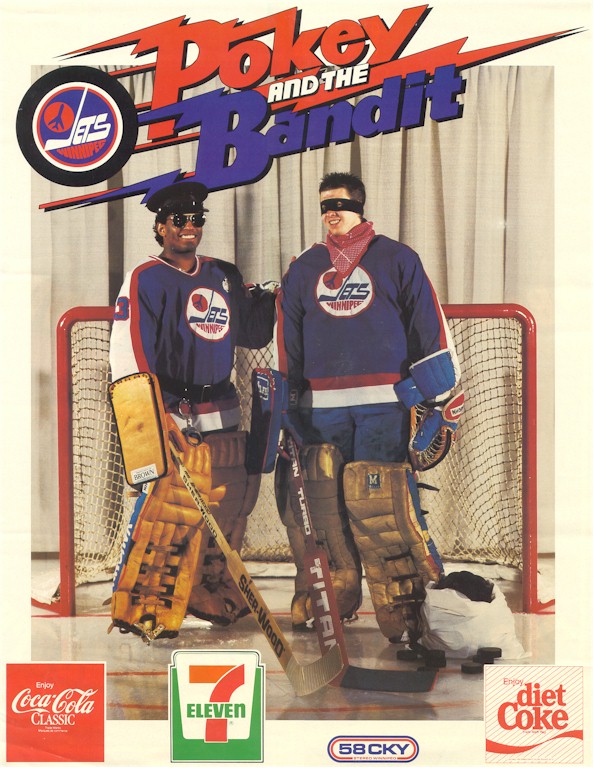
Daniel Berthiaume was one half of the Pokey and the Bandit netminding tandem for the Winnipeg Jets in the late 1980s.  Daniel would play 215 NHL games while playing for 5 franchises over 8 seasons.  He wore a different number with each team.  Berthiuame has traded in his goalie mask for a fisherman's cap as Captain Bert is now a professional fishing guide.

Wednesday, January 4, 2012

TTM: Craig Janney

  Craig Janney was one of the top set-up men of the early 1990s, being in the top 10 for assists four straight seasons.  Janney played in the 1988 Olympics for Team USA and also made it the Stanley Cup final the same season with the Boston Bruins.  Janney never made it back to the Finals.  In 1994, Janney refused to report to the Vancouver Canucks after being awarded as compensation for the signing of Petr Nedved.  The Blues made a trade to get Janney back from the Canucks.  The Canucks would make it to game 7 of the Stanley Cup Finals that season.  Janney would be traded during the next season to Winnipeg.   
  Mr. Janney signed 3 of 3 I sent him and also signed and returned the extra copy of the picture I sent.  I admit it seems kind of random to put Craig Janney as a St. Louis Blue on a 85-86 OPC card, but I wanted a Janney signature on a Blues card and I didn't have any of him as a Blue.  I had just finished the 86-86 OPC template and felt the need to use it.  I wish I used a different design.  Maybe then he would have kept a copy.  The player keeping a copy is almost as a big of deal of getting an autograph return for me.

Wednesday, December 21, 2011

TTM: Doug Smail

Doug Smail played 845 games in the NHL registering 459pts.  He also played 75 games in Britan, registering 204pts.  Mr. Smail was the first player to ever go straight from the NHL to a Brittish hockey league.  In the NHL, Smail was a defensive specialist, excelling on the penalty kill.  He is the Jets/Coyotes franchise leader in short-handed goals.  He was one of a record six player on the 1984-85 Winnipeg Jets to score 30 or more goals.  His 31 goals in 84-85 are the most goals in one NHL season without a scoring powerplay goal.  Cards were sent c/o The Rocky Mountain Roughriders, where Mr. Smail is a coach.

Sunday, December 18, 2011

TTM: Pat Elynuik

  Pat Elynuik was part of Team Canada for the 1987 World Juniors Tournament that ended in the Punch Up in Piestany.  Mr. Elynuik would finish his career with 342 point in 506 career games.
  Sent: November 28th, 2011
  Received: December 16th, 2011

Sunday, December 11, 2011

TTM: David Aebischer

  A nice return from the #2 in career win by a Swiss goalie, David Aebischer.  Aebischer last played in the NHL in 2007 with the Phoenix Coyotes.  He spent the last four season playing in the Swiss league before attempting a comeback with the Winnipeg Jets.  Aebischer currently plays with the St. John's IceCaps of the AHL.
  I sent out a card and 2 pictures, each picture had an extra copy for Aebischer to keep if he desired.  He returned the card and two copies of each picture signed.  He personalized one copy of each picture.  They were sent October 12th and received November 30th.

Thursday, December 8, 2011

TTM: Stephane Beauregard

Isn't it strange how a young hockey fan can attach themselves to a player, seemingly at random?  Stephane Beauregard was one of the players I cheered for a young kid.  Beauregard played 5 years in the NHL, but never posting a winning season. Beauregard's biggest claim to fame was being part of the package, along with a 4th round pick (Eric Daze), Buffalo used to snag Dominik Hasek from the Chicago Black Hawks in 1992.
Mr. Beauregard signed both cards with the #30, even though he wore #35 during his one season with Philadelphia.  Never the less, he has one of the nicer signatures I have received back to date.  


Tuesday, December 6, 2011

TTM: Teemu Selanne

 Where does Teemu Selanne find the time?  From the reports I have seen he is one of the most popular player to send a TTM and he is also one of the most reliable.  He is also known to occasionally send back an extra card or picture.  How many other active NHLers who are future Hall of Famers are so generous to their fans?
  Mr. Selanne signed 3 of 3 in 23 days.  He kept a copy of the picture, as offered.  Thank you Mr. Selanne.

Teemu Selanne

Monday, December 5, 2011

88-89 OPC: Kane, Fleury and Hull

Evander Kane has been tearing it up of late for the Winnipeg Jets, with 9 goals in the past 10 games.  Perhaps it has something to do with his jersey number, #9.  
#68 - Evander Kane
The 1st overall pick in the 2003 NHL entry draft, Marc-Andre Fleury has won a Stanley Cup and an Olympic Gold medal, but is he an elite goalie?  The Penguins were a stacked team when they won the Cup and Fleury spent his time in the press box as the 3rd string goalie for Team Canada in the 2010 Olympics.  Fleury has only once finished in the top 10 in GAA or Save Percentage.  Is Fleury this generation's Grant Fuhr?

#69 - Marc-Andre Fleury

  On March 7th 1988, the Calgary Flames traded Brett Hull and Steve Bozek for Rob Ramage and Rick Wamesley.  The Flames would win the Stanley Cup the following year.  Brett Hull would go on to score 741 career NHL goals.  Good Trade?  Would you give back a Stanley Cup to have the top NHL goal scorer of the 90s with no guarantees of winning another Stanley Cup?  Tough call.

#113 - Brett Hull

Tuesday, November 8, 2011

TTM Success: Dale Hawerchuk

  Excellent return from Dale Hawerchuk.  I sent Mr. Hawerchuk 2 cards and a picture to sign.  I sent an extra copy of the picture for him to keep if he wished, but instead he signed it and returned it.  So I ended up 2 cards and 2 pics signs.
  I sent the letter care of The Barrie Colts on October 11th.  I received the cards on November 4th.